

(Please note all images can be clicked to enlarge)
Like many who ventured into the newly emerging field of Computer Art in the 1970s, Marcus West did not come with a formal background in the Arts. Instead, a strong curiosity to test the boundaries of his mathematical and programming knowledge meant his art ultimately found him. “I had been very good at Geometry when I was at School,” Marcus explained when we sat down together one morning to discuss his work, “I recall getting 100% in a geometry exam, and always had a sound understanding and strong interest in Trigonometry”. This fascination with the way fundamental Mathematical rules can be manipulated to create engaging visual works ultimately led him into a lifelong dialogue between the computer and art.


Getting Started
In 1972 Marcus West took up a Diploma course at Cardiff University College in the new and unusual field of Electronic Music. The course had recently been set up by Charles Taylor who was the Professor of Physics (with a particular interest in musical acoustics) within the University. Rumour had it that the regular Music Department did not want the course within their domain as they considered it too experimental, so instead Professor Taylor found a space for the Electronic Music Studio within the Physics Department building. Really to even offer such an avant-garde Diploma at the time was a credit to Charles and Cardiff University. Following the music course, Marcus West remained at Cardiff to work on a PhD looking at the computer control of musical instruments. As part of this work Marcus began writing his own unique program called ‘Sequemuse’ (short for ‘Sequence…music’) which captured and manipulated small cells of music so they could be built up and repeated into unique larger works. For this he had been inspired by musicians such as Steve Reich.
It was while undertaking his initial Diploma in Electronic Music in the early 70s that Marcus first became interested in the equally new field of Computer Art. He recalls that there was no-one else (he knew of) at the University trying such works, but that he quickly came across the Computer Art Society in London where he became a member regularly attending their lectures and monthly get-togethers. While the shift in interest from electronic music to computer-aided art may seem like a jump at first, in truth there were strong conceptual overlaps in his work for both. In the first instance Marcus’ existing computer programming knowledge gave him experience and a firm understanding for how to manipulate the campus’ mainframe computer sufficiently for artistic purposes, and just as his Sequemuse program was about the way a small phrase of music can be overlapped to create new works, so his style of Computer art would also focus on a relationship with repetition. Indeed, while Marcus and I sat together looking through some of his artistic works from those early days, it was obvious how his fascination with geometry had come to (and continues to) guide his art. He had been enthralled by how simple repetition of angled lines could give rise to intricate Moire patterns, and his artistic output would fall into families of work as he visually explored different geometric and mathematical principles.


The process
Free from deadlines or pretentions, Marcus West’s early computer art was undertaken predominantly for his own interest between 1973-81 and was all created using the Fortran programming language and a Calcomp plotter at the Cardiff University Computer Centre. Without others on hand to learn from, Marcus had acquired a copy of the 1968 Cybernetic Serendipity Exhibition Catalogue and found great inspiration within those works. During the 9 years Marcus created his computer assisted art at Cardiff, he too would explore countless themes and geometric principles as they traversed the endless rolls of plotter paper.
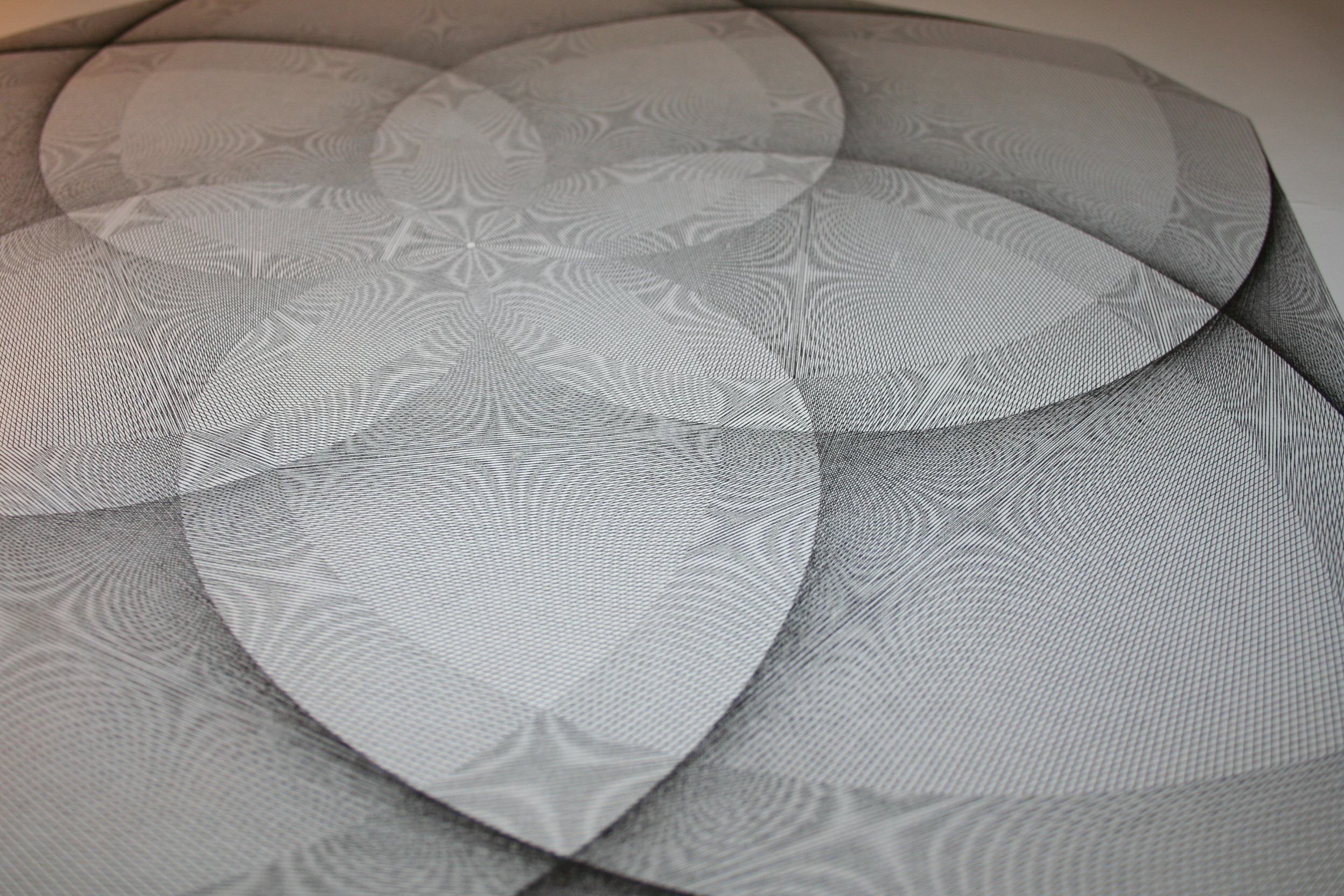
As a process Marcus would begin each work with a firm idea in his head for how each image should be possible and the maths necessary to achieve it. At their core many of his works were based around the careful repetition of just two or three very simple lines. As these marks were slowly moved and repeated, they morphed from simple squiggles into complex and harmonious organic shapes. It was a hands-on and time-consuming process, constantly and skilfully adjusting the computer code for each line the way a wood carver would consciously and meaningfully chip away every piece of the wood to create his work. Once complete, Marcus’ artworks were also far from just decorative achievements. As an artist his talent was not only to bring all the lines to a degree of crisp completion so that the overall form achieved a solidity, but to give them a sense of motion and let that somewhat dictate the final effect as well. Through his painstaking coding the moire effect, for example, could intensify or soften each line and help the eye flow effortlessly around the page. As Marcus would tell me: “The most satisfying thing is to have this sense of a generative principle and tweak it in such a way that it produces something that you weren’t even thinking of when you first thought of it”.


While Marcus would begin each piece with a general sense for how the look should unfold, it would take many weeks of coding, checking, tweaking, and re-tweaking to get to the degree of polished finish he would ultimately be happy with. With each artwork he usually went through at least a dozen re-workings until completely happy that every line flowed and joined the others just the way it was supposed to. Many of his pieces were left un-named or were only named at the end once he saw the finished product. At that point his natural curiosity would lead him to begin the next design. “I was very lucky,” he told me, “Although my drawings sometimes tied up the plotter for hours at a time, the University were very good natured in letting me do them. I remember once the Director of the Computer Centre peering his head into the plotter room and when he saw me, he naturally asked what I was doing. When I told him he kindly said nothing, but I could see in his eyes he thought this was probably a rather frivolous use of his computer and resources.” This look of kind bemusement was common among many at the time Marcus recalls without judgement, but in contrast his works were viewed with praise and encouragement when he brought them along with him to the regular meetings of the Computer Art Society. Of the group he particularly remembers John Lansdown, Alan Sutcliffe and Dominic Boreham with fondness, but it is clear that the atmosphere overall had a very positive effect on Marcus. Ultimately three of his early computer works would go into the permanent collection of the V&A and one would be turned into a poster.
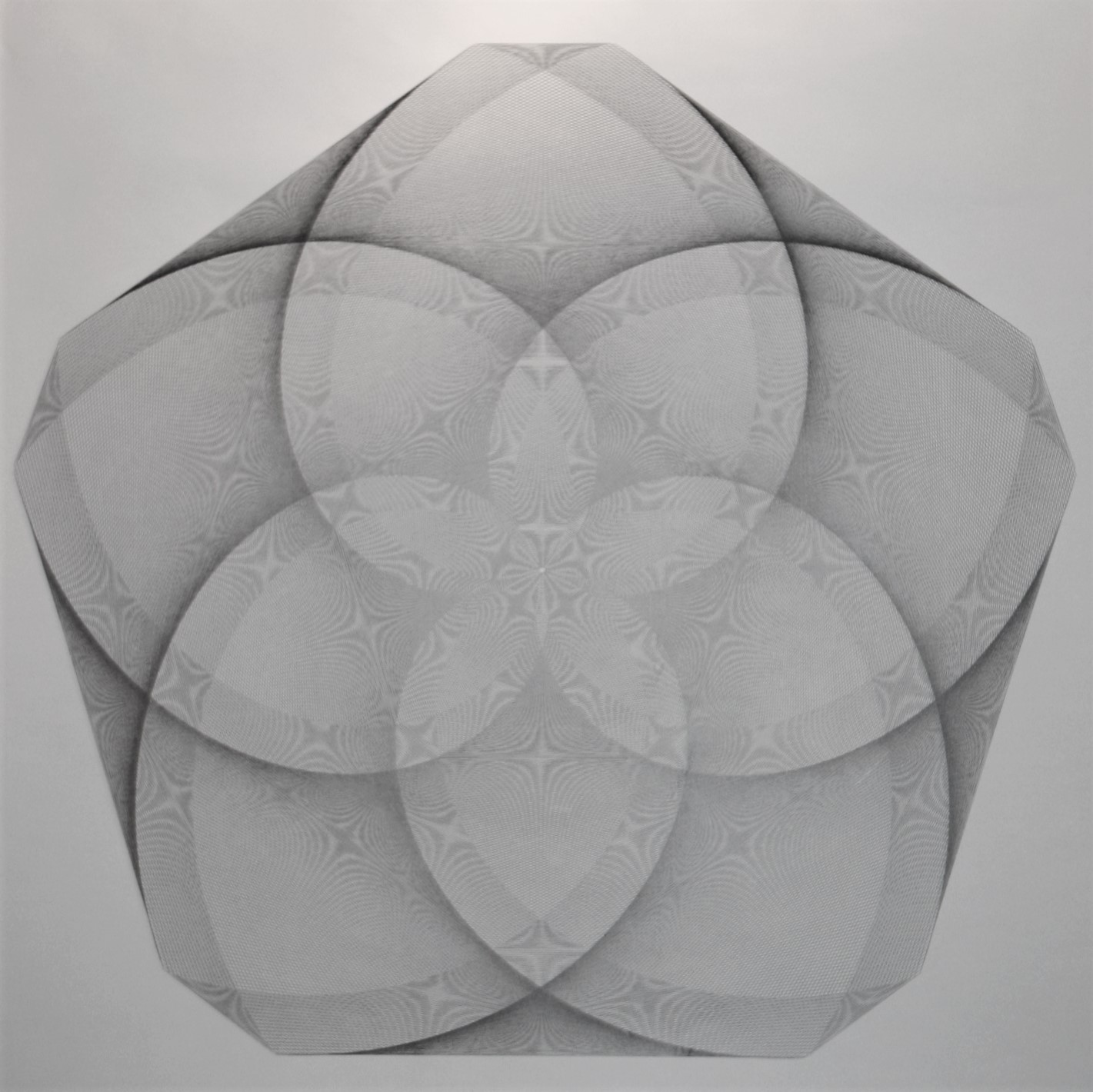
Geometrical Lotus
In 1976 Marcus approached Tim Black at Motif Editions to see if they would be interested in printing any of his computer artworks. Motif was well known in the Computer Art world as it had produced the posters for the famed Cybernetic Serendipity Exhibition in 1968 and had always remained supportive of talented new artists. In 1978 Motif agreed to publish the ‘Geometrical Lotus’ image and settled on a print run of 1000 copies. Interestingly, for its visual complexity the Geometrical Lotus work actually consists of the ingenious repetition of two lines and the title was naturally a reflection of the final form created. When I suggested that the piece and title had a clear Hippie feel to it Marcus wryly smiled and commented “yes just like me”.
Moving on and Moving Forward
By 1982 Marcus West’s regular career and life had got busier. Because he no longer had easy access to the University or Computer room his computer art came to a halt for the time being. Indeed was put to the side for two decades until Marcus went to a retrospective exhibition at Tate Britain of Bridget Riley in 2003 and the creative spark in him was re-ignited. Much like his earlier work, Marcus’ computer-aided art from 2002 onwards has remained rooted in his love for the artistic expression of geometry and has drawn inspiration not just from Riley but also Victor Vasareli. Like before, the later works have fallen naturally into families of ideas based around core concepts such as the Fibonacci sequence, Golden Ratio, harmonographs, tessellations and more. Yet unlike his early work (which had to almost be wrestled from the Mainframe), these later works are created and manipulated on his own home computer and often possess a thoughtful humour to them. This can be reflected in their titles such as “Sinusoidal Rainbow by Day and by Night” or the wonderfully named. “Left and right angle fish from the school of Pythagoras.”


As well as the works in the V&A, Marcus has exhibited at several galleries and from 2006-15 regularly had works included in the noted annual ‘Discerning Eye’ exhibition in London. In 2015 one of his works ‘Fibonacci Image with blue cells emerging from an orange background’, was shortlisted for the Lumen Prize, an international competition for Digital Art.

Two of the things I particularly admire about Marcus West is his lifelong adventure into the beauty of geometry, and his commitment to the field of computer-aided art. From his initial 1970s plotter drawings which took sweat and dedication to even achieve, to his more recent pieces which jump from the screen through their clever interplay of colour and form, Marcus has remained fascinated not just with the finished effect, but with the very process of creation. As we stood looking over some of his works and he began to explain the intricacies of how each had been built up in the first place, I got the sense of a man almost proudly discussing his children. The excitement in his voice recalled the journey each picture had taken from the mere concept of an idea all the way through to the finished and striking artwork in front of us. And while the finished artwork had ultimately been for us to enjoy, the creative journey Marcus had to explore, had very much been there for him.

For further information Marcus can be contacted at: marcuswest@btinternet.com
Image Attribution: All images copyright of Marcus West