
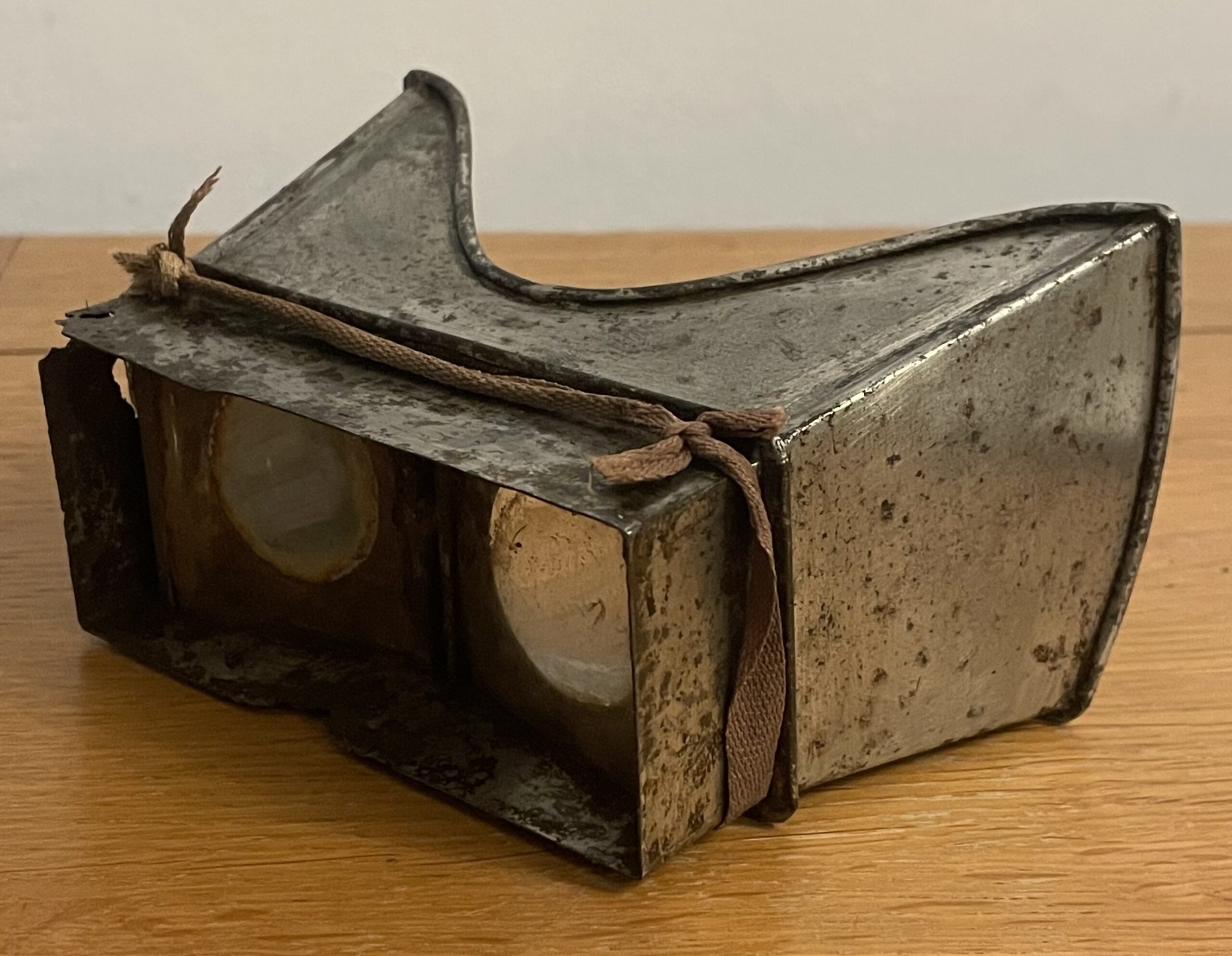
The other week I discovered an item that at first glance looks quite unexciting but is actually a very significant object in the prehistory of Cinema. It is the eye cover (cowl) from the original US patent model for an optical toy called the Kinematoscope. Invented by a noted Philadelphia-based engineer named Coleman Sellers II in February 1861, the Kinematoscope is the earliest known patent for a device that used photos to mimic motion. This naturally makes it a pivotal invention in the pre-history of Cinema (as well as 3D history because it used stereoscopic images rather than just single cells). Just as importantly our term ‘Cinema’ was derived from ‘Kinema’, the effect created by this Kinematoscope. Coleman Sellers in his 1861 patent document states ‘The name I design giving to the instruments embodying the principles of my invention is “Kinematoscope”, which is intended to convey the idea of ‘I see motion’.”

The mid 19th Century was an exciting time for photography and Charles Wheatstone’s Stereoscope (invented in 1832) was sweeping the world as a sought after parlour toy. The next natural progression to viewing photographic images in 3D was of course to make them appear to move. Others had come up with sequential drawings or rotating discs to mimic a sense of movement (such as flick books or the Stroboscope) but Sellers appears to have been the first to use photographs. Just as importantly, he realised that for us to perceive still images as moving, each sequential image needed to be viewed as static just long enough for the mind to recognise it. Our brains then connect the dots between these stages generating a sense of movement. Without that momentary pause, any sequence of pictures would just look a blur to us. This observation became one of the founding principles of motion films.
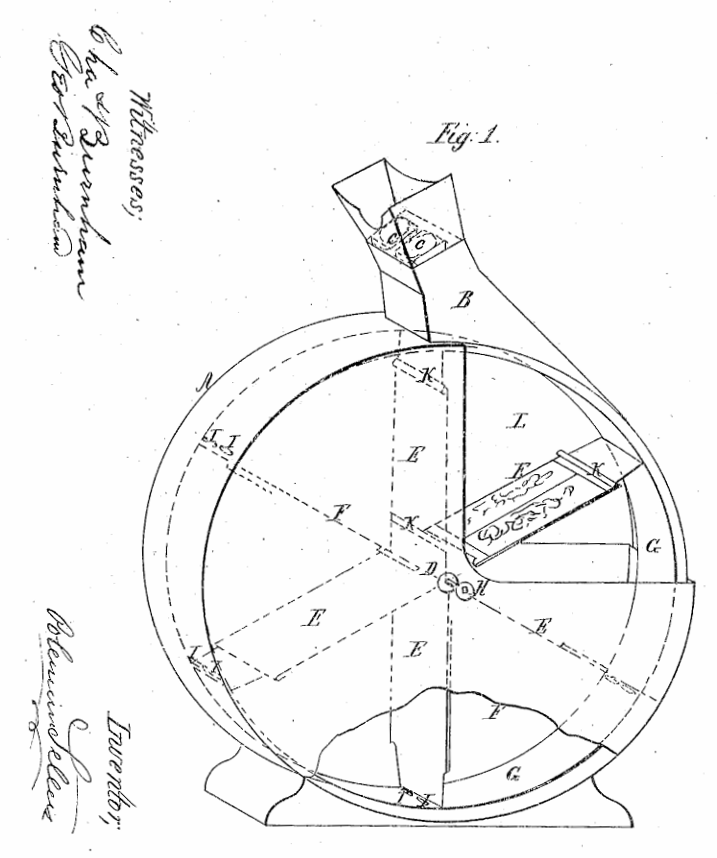
There is plenty of information online about the Kinematoscope and Coleman Sellers.
While the Kinematoscope showed the world that a moving image viewer was possible, the inventor himself saw it as little more than an interesting toy and apparently soon lost interest. As far as I can tell, this patented design was never put into commercial production and only a few working examples were made. One was the original US patent application model (of which I now own the viewing cowl), another was for Sellers himself and was ultimately left to the Franklin Institute where he later became President. I also suspect a few examples were probably made for interested colleagues such as via the Photographic Societies and Scientific Institutes Sellers was a member of. However so far I can find none except the Franklin institute example to survive.
Original Kinematoscope motion picture using Coleman Seller’s children:
US Patent Models
US patent applications before 1880 required a scale model of the invention to be submitted along with drawings and a description. This model was supposed to be no larger than 12 inches square although it appears this was not always strictly adhered to. When the application was successful the patent model would be given an identification tag held on with ‘red tape’ (hence the phrase) before being permanently stored or displayed at the Patent Office (USPO). A large fire at the USPO in 1877 destroyed around 100,000 of these models, but thankfully this Kinematoscope must have survived. In 1893 the US Government decided to place the surviving patent models into storage, but at the start of the 20th Century they then decided to dispose of them instead. Some were dispersed to museums such as the Smithsonian, some were returned to their original owners, and the remainder were sold off at public auction. Sadly for some sold off at auction it was also a story of neglect. According to the history I can surmise, my Kinematoscope was part of this neglected group which sat in a barn in upstate New York for decades. It only came to light recently alongside dozens of other neglected patent models and my cowl (viewing hood) still retains its original but faded red tape. From the corrosion present the whole model must have been stored pretty badly and at some point the rest of the model became detached from this cowl. So far I haven’t been able to track down the rest of this fascinating patent model and it may sadly be lost for good, but I really hope not as it deserves to be reunited and placed in any relevant museum or collection to be enjoyed again !
Link to a visual overview of the Kinematoscope:
Kinematoscope: Deep Dive Into Early Motion Picture Technology