

(All references have been included as links within the text.)
When one mentions fax machines, it is natural to think of those 1980s and 90s machines we all proudly owned to send illegible hand scrawled messages to the distant family or boss. However few people realise that the first attempts at the fax machine really date all the way back to the 19th Century. The first successful machine was invented by German Physicist Arthur Korn in 1907 and was called a Bildtelegraph. This required connecting to the telegraph and was used across Europe. It was followed by Edouard Belin’s ‘Belinographe’ of 1913 which used the telephone network. In 1923 it was reputedly adapted to work via radio signal too. Then in 1927 an Englishman named Otho Fuller patented his own device which was able to receive and print pictures via wireless. In many respects this was not the fax machine we know today as the signal was not sent via a telephone line and only carefully prepared images could be received. Instead, the message was transmitted via regular radio transmission for interpretation and printing on a patented Fultograph. However, in the evolution of the fax machine this was a big deal.
Despite the Fultograph being very well publicised at the time, little is known today about this fascinating machine and less about the man who invented it. A quick look on the internet tells you that the inventor Otho Fulton was born in Vienna Austria on 1st August 1867, lived in London till the late 1920s, identified as English, moved to France for a few years then on to New York in the early 1930s where he finally died of a heart attack on 28th February 1938 aged 70. Beyond this the information becomes patchy. There are references that Otho was of Magyar Origin, and that he was close friends with Robert Baden Powell with claims that he became the 3rd person ever to be enrolled into the scouting movement. I’ve yet to confirm these claims, but we do know that Fulton was a Captain in the Army for many years (which is probably backed up by the fact that many of his 5 children were born in different countries). It is also referenced that he was a director in the English General Electric Company and held multiple patents related to photographic replication. This would make sense but Otho’s personal history is sadly something that still needs a lot more research because it feels like he was a fascinating and talented individual.
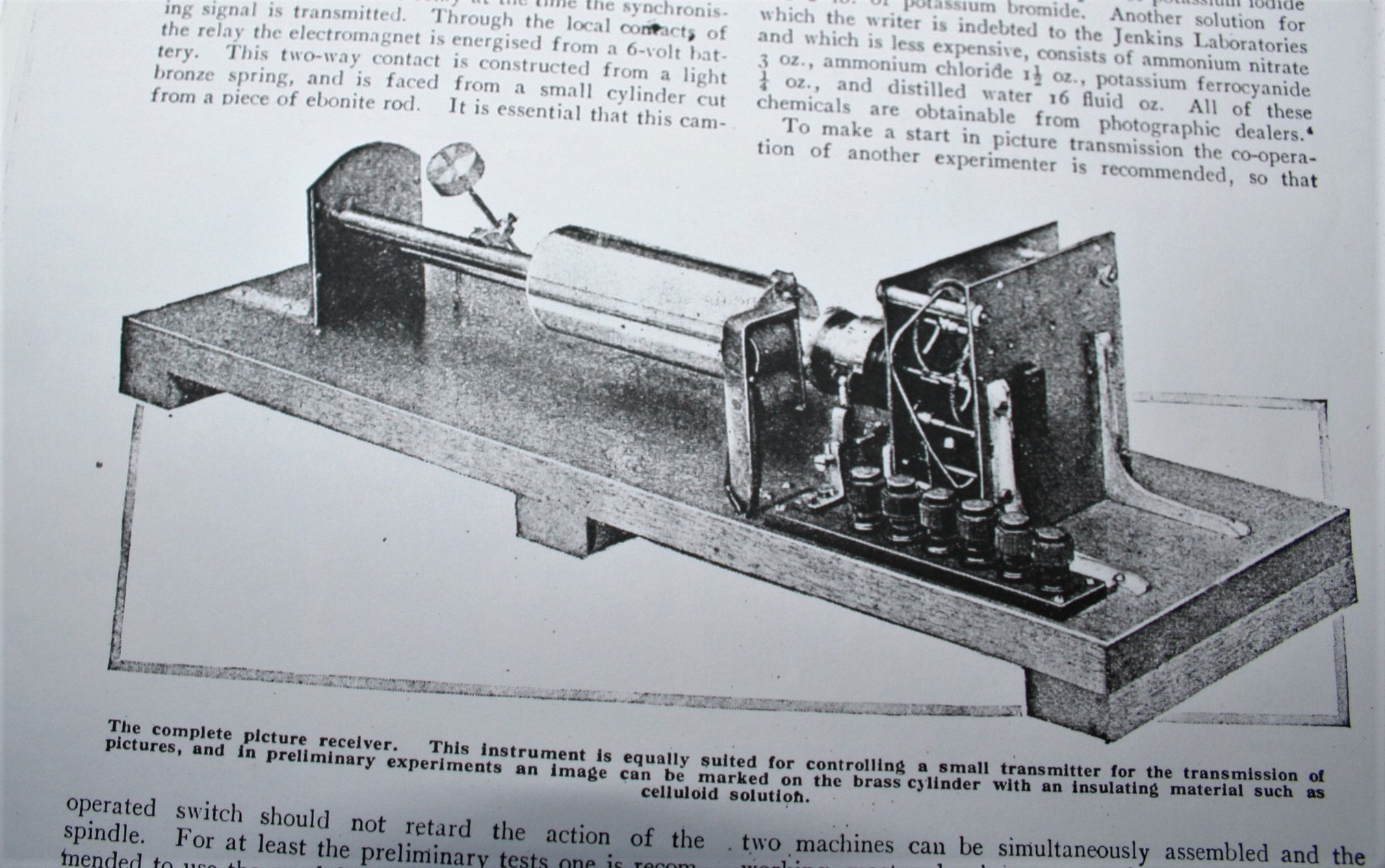
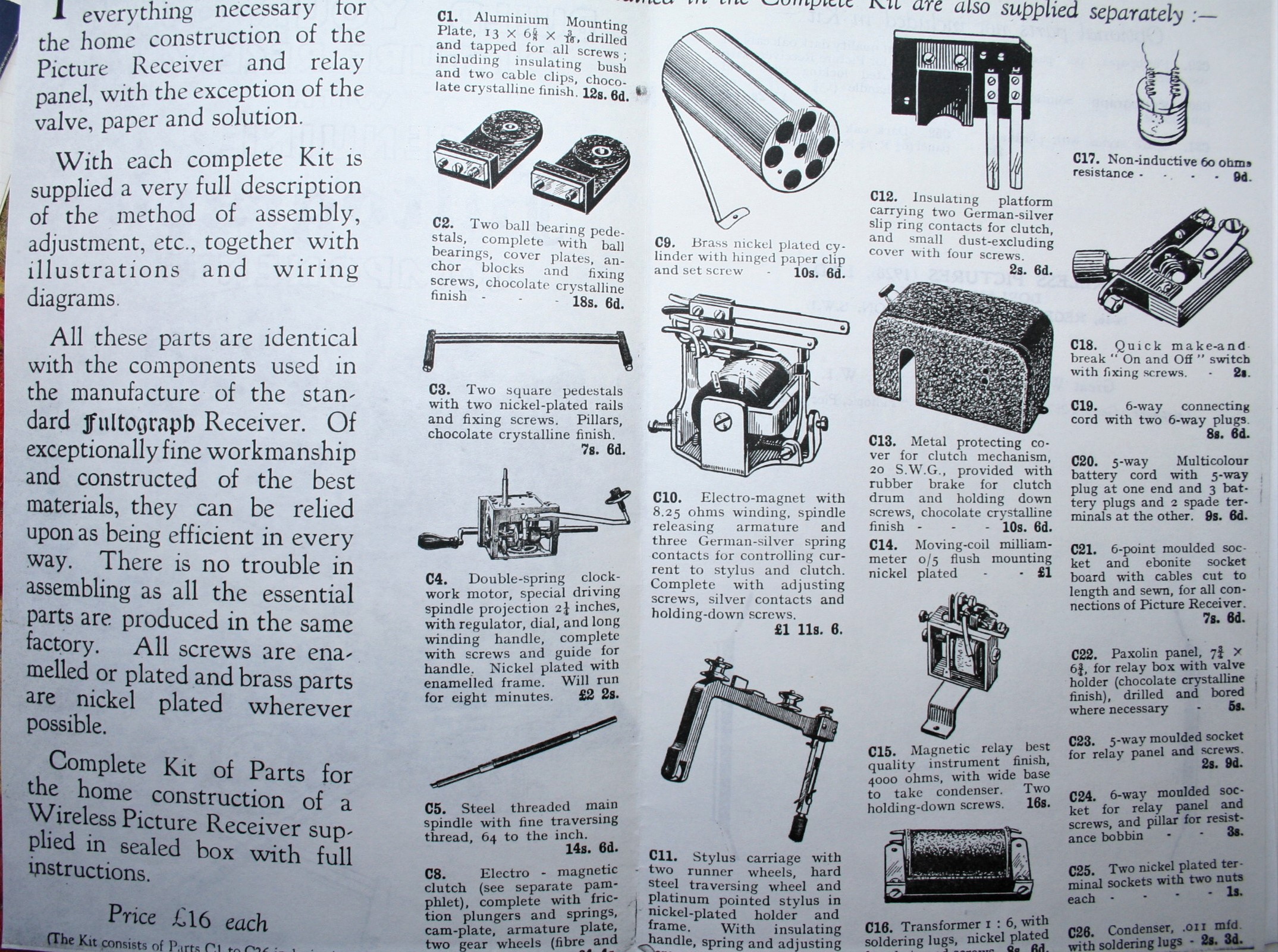
What is better known is that from the time of his initial 1927 Fultograph patent, Otho put all his energy into changing the world of facsimile reproduction. He went into partnership with T Thorn Baker and a firm called W. Watson & Sons. Together they set up a company called ‘Wireless Pictures Ltd’ in 1928 to produce and market his new device. The commercial machine (which he obviously named after himself ‘The Fultograph’) looked in many respects like a regular cylinder phonograph from the start of the 20th Century. In a fumed oak or mahogany case, it had a winding handle, double spring, floating stylus and an alloy cylinder upon which the paper (pre-soaked in a potassium iodide and starch solution) was laid. Infact, perhaps one of the reasons these machines are so scarce today is that unless you knew otherwise, most people would assume it was just a regular phonograph. The Fultograph would be connected-up to a radio speaker and when the signal was received the stylus would scratch the image onto the paper. In truth the image never lasted that long and was prone to giant errors, but since no-one else had managed to efficiently send tonal images before the invention was still a pretty big deal. It took around 3-5 minutes to transmit and print out a single picture 9-12 cm in size.

One of the many Fultograph patents describes it as:
‘Receiving device for telephoto, type printing and similar telegraphy. An electrochemical reaction is used on the receiving side to make the current pulses from the transmitter visible again. For this purpose it is known to stretch the appropriately prepared and impregnated papers onto a cylinder, to let it rotate and to build up the image on the form of a fine spiral line by means of an axially displaceable contact pin, synchronously with it to avoid correction (“stop and start”), ie to stop the cylinder briefly after each revolution and to trigger it again with a signal from the transmitter….”
Besides the interesting way which the pictures were sent, what really made the Fultograph clever was its synchronising mechanism that allowed the machine to split up the incoming audio signal into separate lines of print. This was important as if it didn’t the effect would have been an unrecognisable series of marks on the paper. The machine received very good press when it was launched, and with it lots of different people thought about how they could adapt the Fultograph process to their own needs.
The BBC tests
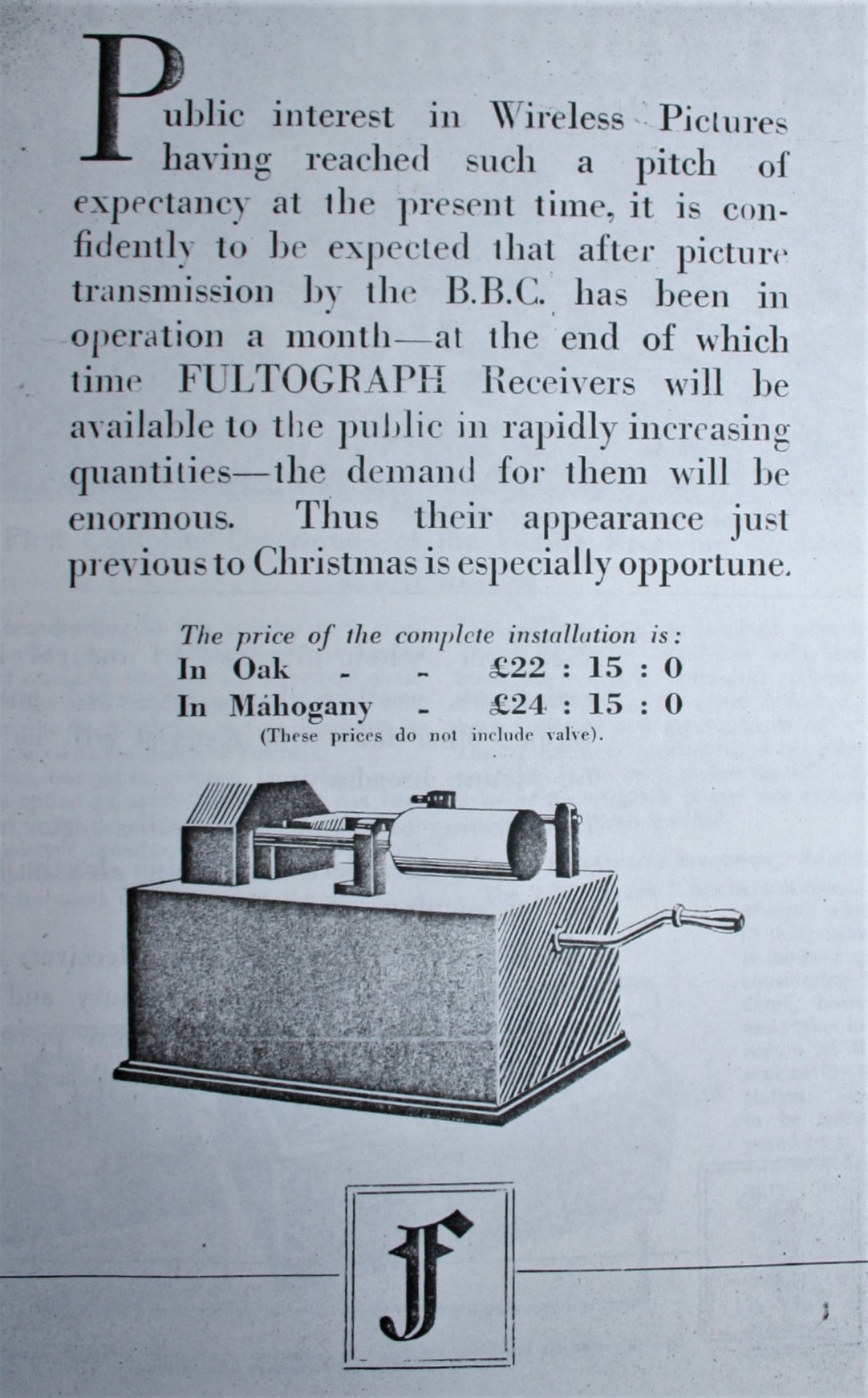
The BBC were one of the early groups willing to test out the long-term viability of the Fultograph for their audience. In 1928 the BBC radio broadcasting service was exploding in popularity, but in contrast their work on the development of a Television service was still some years away. What the Corporation realised was that although the cost of purchasing a Fultograph remained high (£16 in kit form, £22 15 shillings in oak; £24 15 shillings in Mahogany), once you had the machine the cost of printing out images was minimal to the user. There was certainly a desire within the BBC to widen their offering to their loyal radio listeners, and it was felt that the Fultograph was possibly the novelty device to achieve this.
The first Fultograph high definition test signals look to have been carried out by the BBC on the 30th October 1928 from the Savoy hotel and included images of King George V, the British Schneider Trophy aircraft and a cartoon entitled ‘Seeing is believing’. Since it proved to be a success, a regular series of broadcasts were then agreed and an image was transmitted every day except Sundays and Monday at 2-2.30pm from the 5XX Daventry station. It looks as though transmissions continued on and off by the BBC at least up to March 20th 1931 but these later transmissions may have been more research based than aimed at the average radio listener. The 1931 signal was sent on behalf of the Radio Research Board from the BBC Daventry transmitter (193kcycles or 1554m) . During its transmissions the BBC regularly sent images of famous stars as well as puzzles and visual games for their listeners to interact with. Beside their own publicity I’ve yet to find much evidence about the transmissions and I suspect the average person struggled with the common synchronisation issues that were caused by atmospheric conditions. Either way these public BBC transmissions lasted merely a few years, and when they ended they effectively left anyone who had saved up to buy themselves a Fultograph with a basically useless machine.
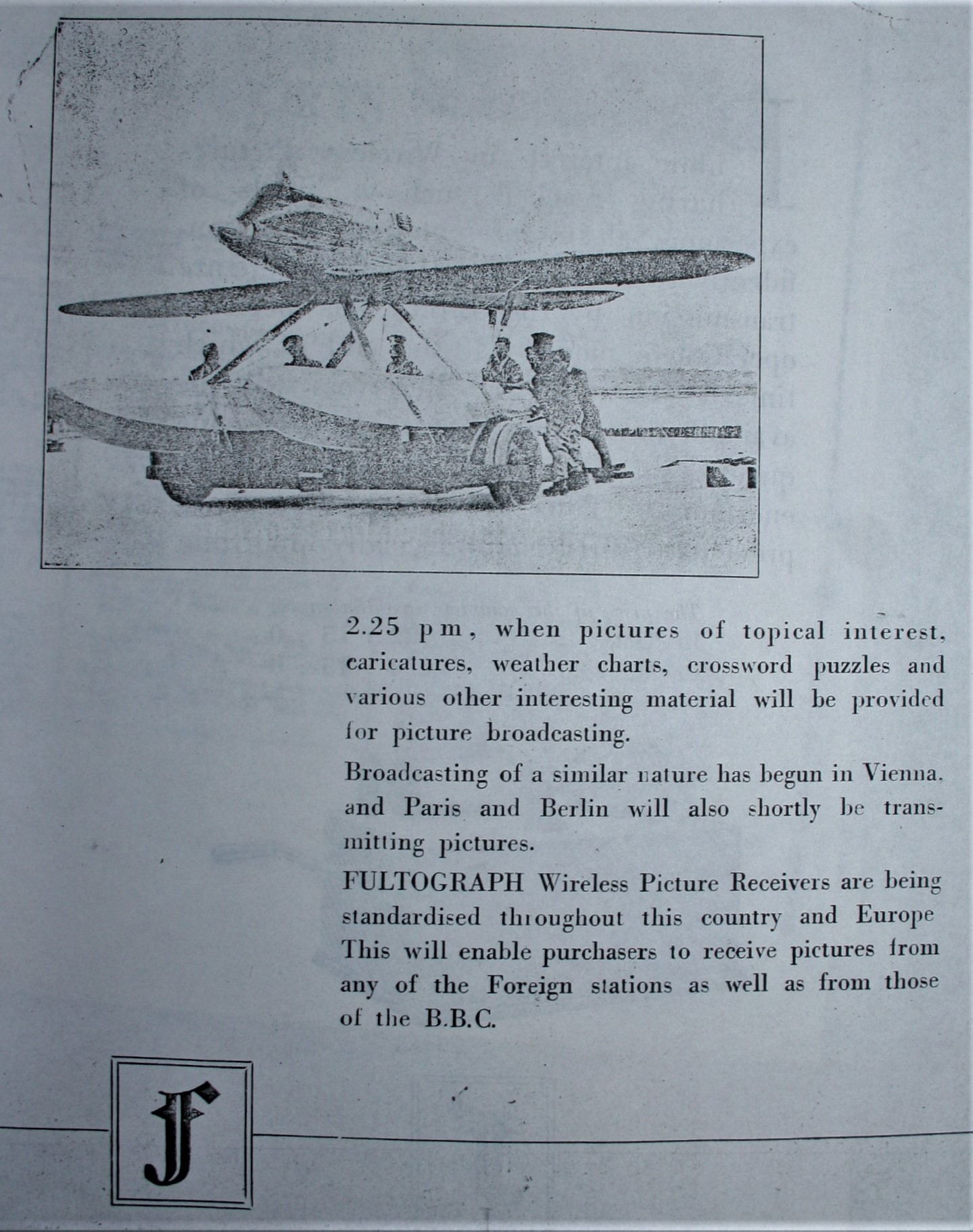
Beside providing entertainment-based images to the public via the BBC, several other groups attempted their own Fultograph tests to see how practical the machine might be for their use too. These tests took place across Europe but included the British Royal Navy, British Weather Service, and German Airlines.
Royal Navy
Research using the Fultograph principle began at The Admiralty Research Lab in 1928 with the aim of using it to create an electrochemical range recorder. Before Sonar had been invented the Navy were still looking at different underwater detection systems so they could plot the location and movement of both ships and submarines. The Fultograph technique was initially tested as a purely research based device to chart echoes and reverberation, but in the long term its principle became the cornerstone of the Admiralty’s ultrasonic magnetostriction echo sounder. This device was 1st fitted to Royal Navy destroyers in 1932 and would prove highly important to the navy until the emergence of sonar some years later.
Weather Service
Another possible use of the Fultograph was to broadcast weather maps and this began across Europe in 1929. Although the connection between a fax machine and weather charts may seem obvious now, at the time all weather charts had to be transmitted via words and code then redrawn up in each location by the trained meteorologist. This was a time-consuming task, so the idea of a fax machine that could transmit the same chart to multiple receiving stations around the world was naturally appealing.
In 1929 Robert Watson Watt (the man who later helped invent radar) demonstrated at the Symon Memorial Lecture the meteorological use of facsimile and reported on the British Meteorological Office’s trials of transmitting simple weather charts by radio from Cardington to an air ship in flight using the fultograph process. These tests compared favourably with the radio maps that were being transmitted daily from Munich by the Dieckmann process for the prior three years having been received for example, on board the airship “Graf Zeppelin” during some of their cruises. In the same year the commission for Synoptic Weather Information of the IMO established a sub-commission to consider the best way of utilising wireless pictures in synoptic meteorology. A weather mapping service was one possibility.
The Ditton Park Weather Mapping Service in collaboration with the BBC agreed to institute a Weather Map Service. They conducted tests which involved transmitting a picture of a piece of graph paper to different observation stations who would each mark it up with their relevant atmospherics and fax it back to the main Slough office. In this way a reliable larger map could be assimilated from the co-ordinates and any disturbances tracked in almost real time.
In October 1929 the German firm of Lufthansa conducted a series of successful tests which involved sending weather charts by radio to their flying planes. A fultograph was attached to the regular radio apparatus of the Junkers plane and over it a weather chart, sketch of the landing place and a graphic description of an approaching thunder cloud were said to have been received clearly within 3 minutes for each picture. Live weather mapping for planes was obviously an important consideration as the airline industry began to grow and the report at the time concluded that eventually all German planes would be equipped with Fultographs.
The End of the Fultograph Story…..
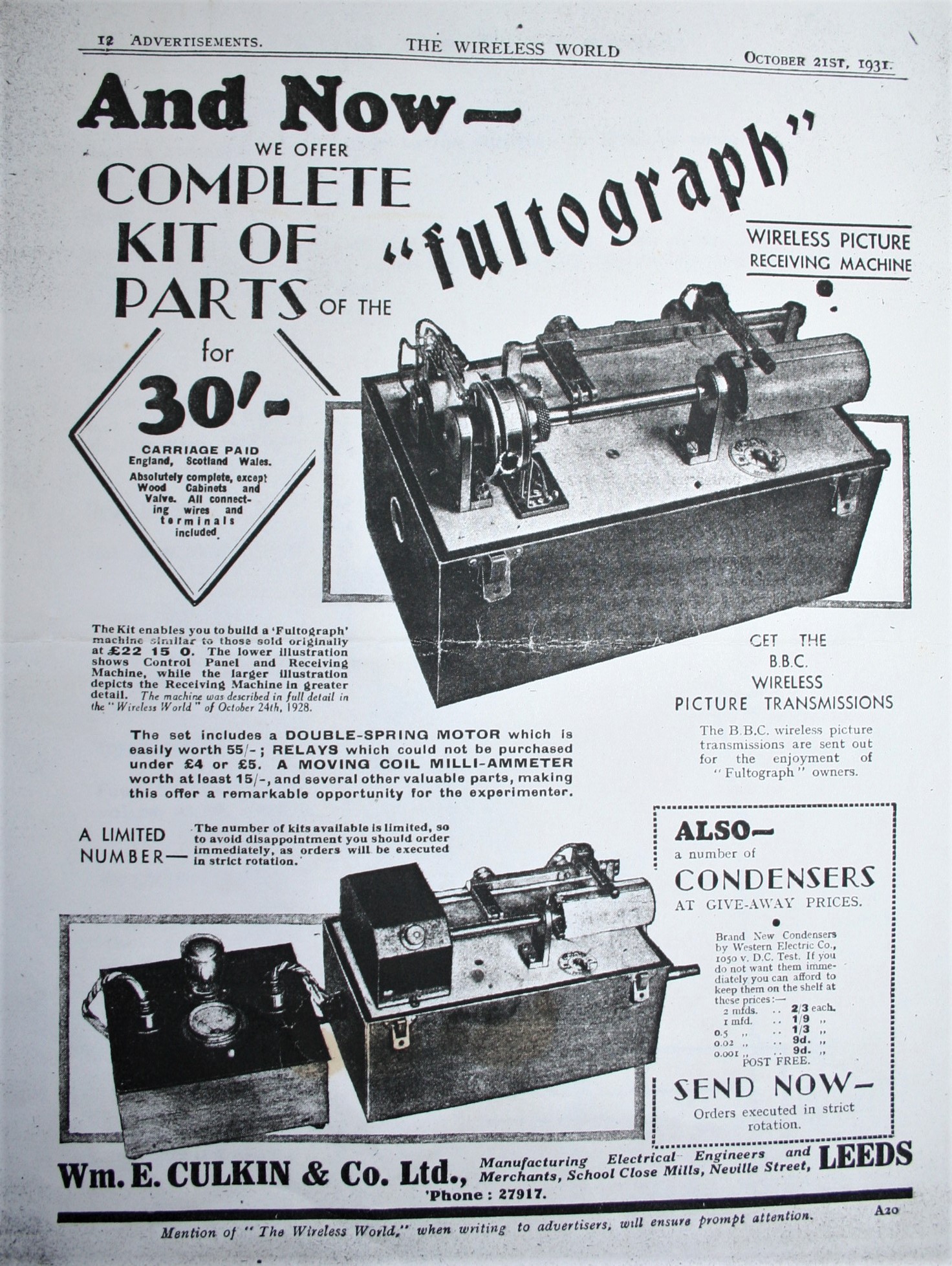
Despite all its positive press and various attempts at being useful, by the middle of the 1930s the Fultograph had already been forgotten. In 1928 the machine had sold for up to £24, by 1931 it had been reduced to as little as 30 shillings (equal to £1.50 at the time). In 1930 Otho Fulton travelled to the US and then again in 1931 when he moved to New York permanently. I believe he was trying to drum up support in America for his ailing Fultograph, and funnily on the second journey (1931) aboard the ‘Ill de France’ his occupation was recorded as ‘inventor of television’. As we know that title really went to others, but it does suggest that either Otho felt his machine was of great importance or he wasn’t sure how else to describe his invention to the shipping clerk. He remained in New York until 1938 when he suffered a heart attack and died, but in the intervening years had continued to refine his invention and submit various patent improvements to his creation. The timing of his death sadly could not have been worse as in Jan 1936 Otho had applied for a new ‘apparatus for use in facsimile transmitting operations’ which employed a pair of synchronous machines with a continuous roll of paper running through a light sensitive read-head coupled with a stylus/pen/pencil. This improved design was conceptually far closer to the modern fax machines which would emerge from the 1950s onwards, but sadly this patent was not granted until Aug 16th 1938 -6 months after Otho had died. Had he lived a few more years I’m sure Otho Fulton would have been a far more dominant name in the development of the Fax machine, but even so we will always have the Fultograph to remember him by.
An evaluation
In evaluating the Fultograph it is important to separate its potential from its success. As a concept Otho Fulton’s 1927 device was a step in picture transmitting technology, and by making use of the existing extensive radio network he limited the need for a brand-new communication infrastructure. That several different industries were willing to trial the device shows that it achieved a great deal of recognition, at least for the first few years. There were of course teething problems which held the machine back mainly around the quality of the synchronisation and the quality of the image. In 1929 a Captain RH Ranger created a very similar device to Otho’s which instead of chemicals burned the image onto wax paper in proportion to the intensity of the signal. It is clear therefore that others were already attempting to improve upon his idea. However in the end it was not the quality of the image which caused the Fultograph to fail, but television. By the early 1930s television was finally reaching a point where a public service could be considered, and with it we rapidly forgot what a Fultograph even was.
If you read German then here are more documents about the Fultograph: (https://www.radiomuseum.org/forumdata/upload/Fultograph_radio_diehr_1928.pdf)