
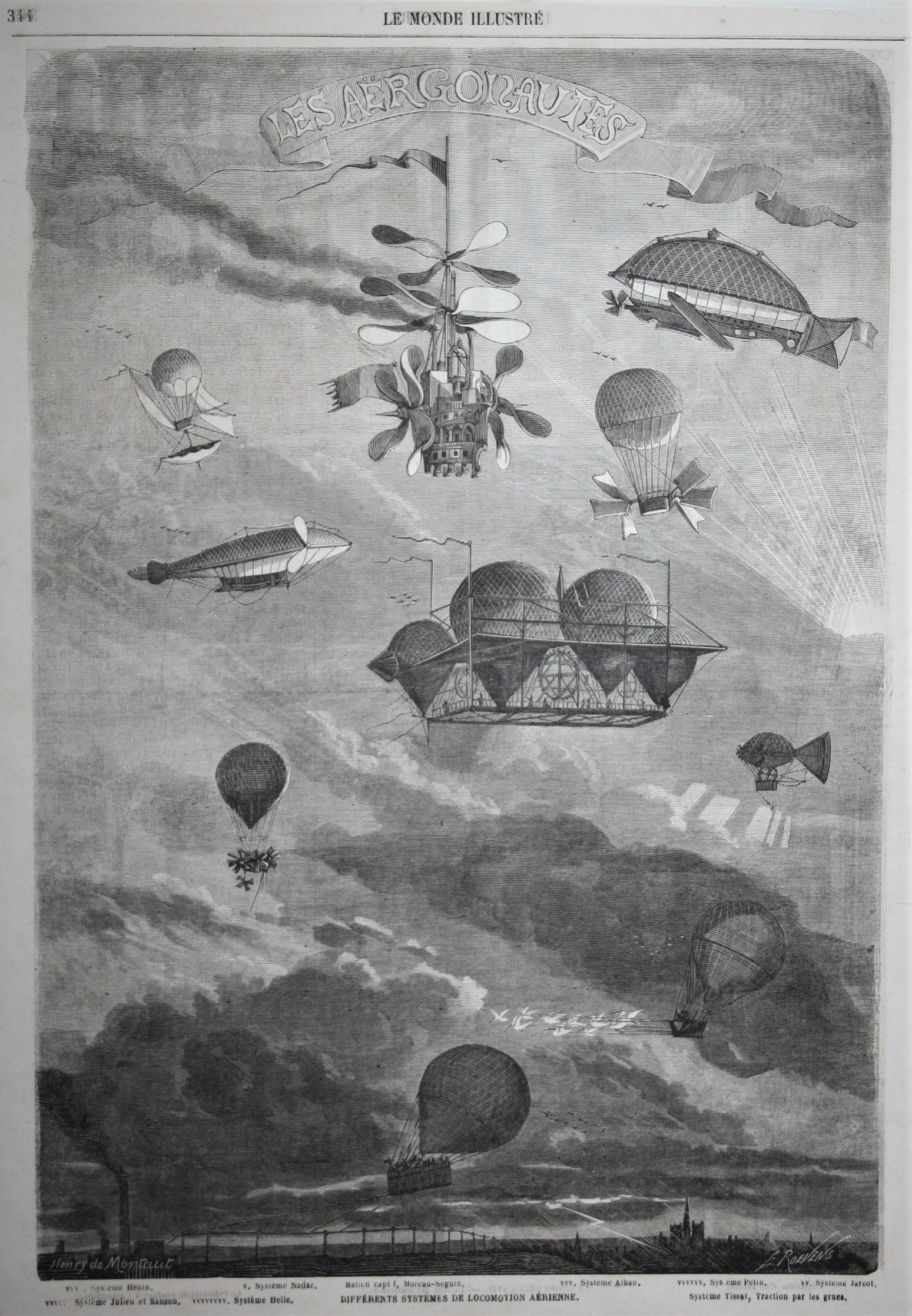
If you look through history you’ll find a wide array of fantastical flying vessels thought up by the minds of men sadly too early in the aeronautical story to ever be achievable. Most of these vessels date from the late 18th Century all the way through to the late 19th Century and in most cases all we have are small artists impressions left in printed newspapers and magazines. These are visually fun drawings, and with the benefit of hindsight we know they never would have left the ground.
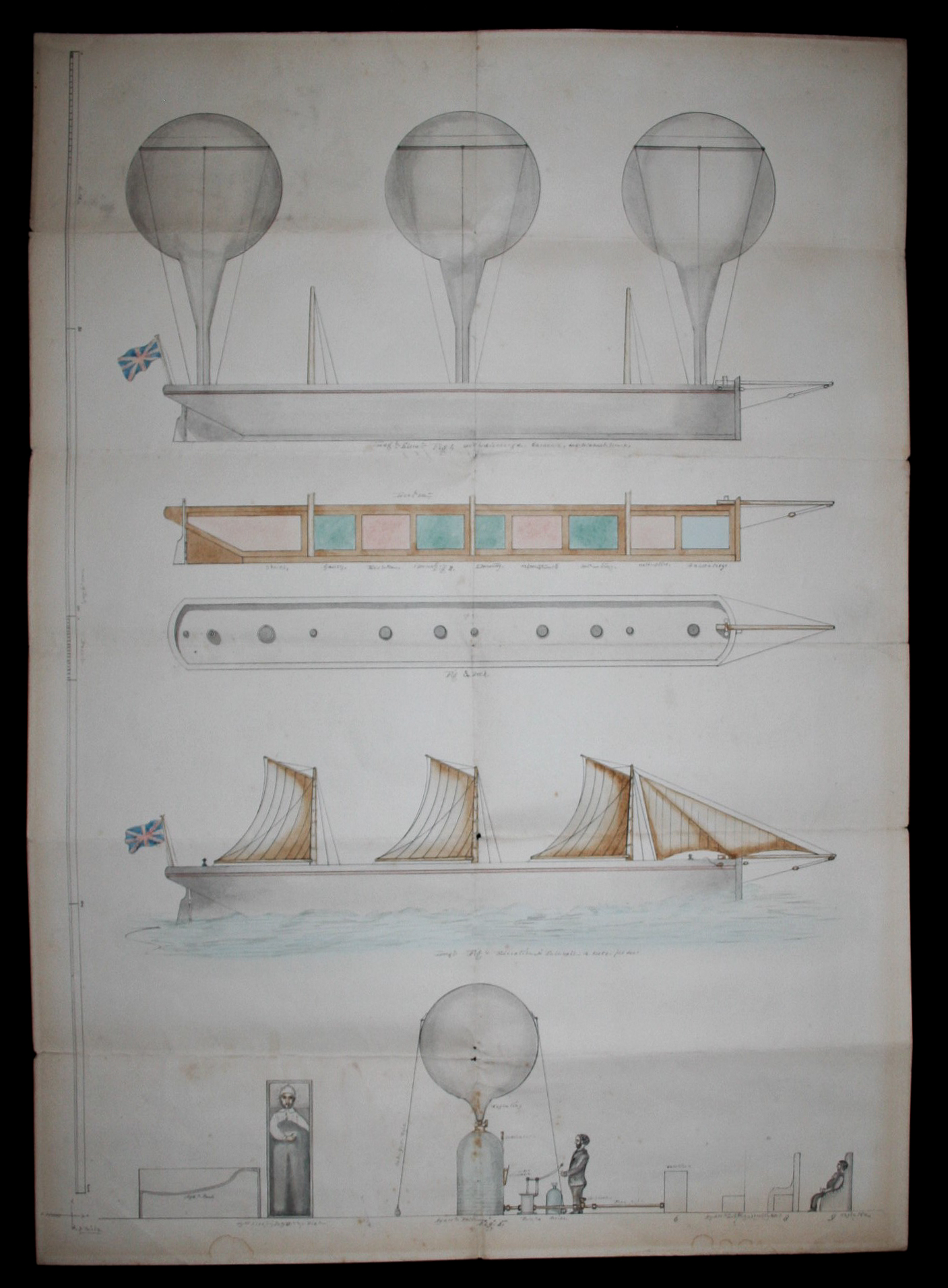
The other day I was excited to purchase an original concept or patent drawing for one such flying boat which dates to around the late 1860s-1870s. It is impossible to pin-point the exact date more than this, but it puts the drawing firmly into that golden age of flying boat design. Although the concept was simple enough by employing three large hydrogen balloons to lift a wooden boat into the air, the page contained a useful scale on the side leaving me to wonder just how viable or impossible this design would have been had someone actually built it?
Of course, once I started looking into the maths I realised all too quickly what a quagmire of unknown variables this calculation involved, but decided to come up with some arbitrary result anyway (no-matter how full of holes). May I remind you that I am neither a marine engineer not maths professor but a simpleton antiques dealer, therefore if you would like to prove me wrong and improve upon my attempt- I would love to hear from you!!
For my own sanity I thankfully found the internet full of people offering relevant equations or relevant results for different measurements which I could estimate my own needs from. I found myself trolling canal and sailing boat chat rooms and peering at tables for lots of beautiful antique and vintage vessels trying to glean clues to their build, weight and dimensions. Once again let me remind you that my result is a semi-informed guess at best, but perhaps a guess is better than no attempt at all.
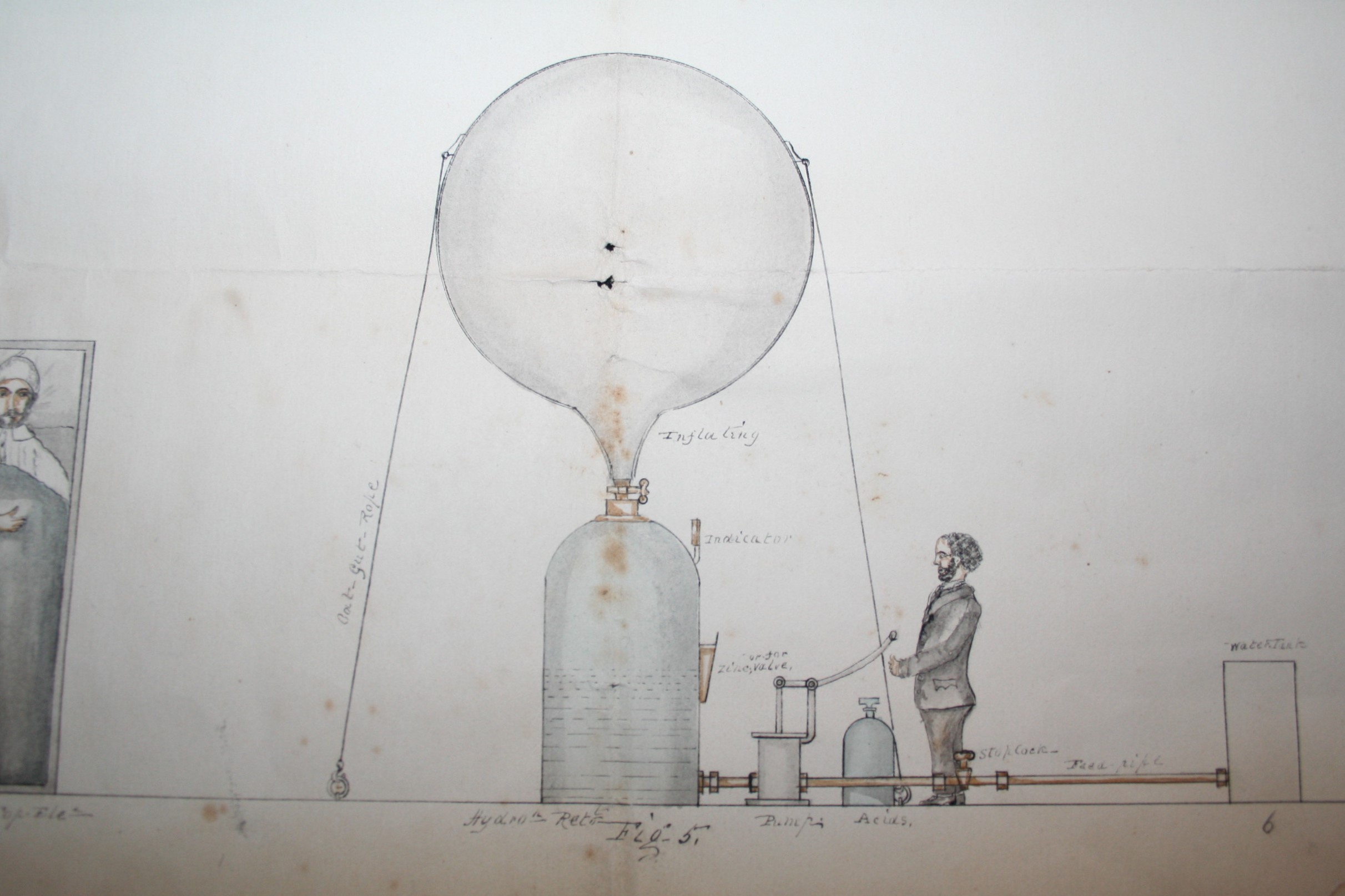
Question: Would my hydrogen-fuelled flying boat design from the 1870s have been able to lift off the ground?
Short Answer- No, not even close!
Slightly Longer Answer- According to my calculations the three balloons had a combined lifting capacity of approximately 7.9 tonnes but the ship would have weighed in excess of 35 tonnes. Therefore the design would have had a better chance had the boat been at least 4-5 times smaller/ lighter and launched from dry land. In its present form (being blown wildly through the ocean waves) it would have looked quite impressive to any on-looker, yet would have stuck to the water like glue.
To put everything into better perspective the three hydrogen balloons on the drawing would have been able to have comfortably lifted a modern fibre-glass Cabin Cruiser and contents or an African Elephant (whichever looks more impressive in the sky!).

Finally, even if my 1870s flying boat design had miraculously lifted into the air somehow, the use of highly volatile hydrogen gas would most likely have caused a catastrophic explosion bringing it crashing back down to earth all too quickly…….back to the drawing board I guess!
Here are my main measurements and assumptions:
What is elusive about the drawing is that there is a separate scale for the balloons and the keel. Had it been drawn to an accurate scale the balloons would be twice the size they are compared to the boat.
3 x Balloons: 50ft in diameter x 100ft high each. Made obviously of some form of rubber and lashed down by goat-gut rope.
Potential Lifting Capacity of 3x Balloons: 7.9 metric Tonnes
Volume: 4/3 x 3.14 x 15,625ft squared= 65,417ft sq per balloon x 3 = 245,312.5 ft sq.
As Hydrogen is 14 times lighter than air = 17,417 lbs or 7.9 metric tonnes
Wooden Keel: 100ft long x 11ft wide beam x 9ft high inc draft. Made of unknown wood construction.
Its form is far closer to that of a narrow boat so would have been quite unstable as a sea-faring vessel.
Estimated weight of keel: 35-40 metric tonnes
This figure is extrapolated from the weights of a handful of known old wooden Schooners and adjusted to our dimensions. Naturally the weight could have also been worked out from the displacement of water in relation to the size of the keel, but as there remained many unknown variables (including density and size of timbers, true draft and weight of the fittings including belongings, water on board the steel hydrogen tanks etc) working with known weights seemed best.
Photo attribution: Flying Animals by Seriykotik1970