

The days following Christmas are a time when everyone gets to put their feet up, turn on the Television and get lost in the inevitable re-runs of seasonal classics and wholesome family gameshows. It is a ritual we quietly revel in and is only made sweeter by the sparkling technicolour of the images on the screen in front of us. But there was a period, back in the mists of time, when televisions only came in black and white.
The birth of television took place in the mid 1920s (although experiments had been conducted even back in the 19th Century). As often happens, several different people around the world were all working on the problem at the same time, yet it was the Scottish inventor John Logie Baird who got there first and is ultimately credited with the first successful television system. After demonstrating his new ‘visual radio’ in 1926, his first commercial television (called the Televisor) would go on sale in 1929 selling around 1000 sets over the next few years. But television then was not what it is today, and apart from the fact that it produced a barely recognisable image the size of a postage stamp, it was also hand-cranked and even if you were brave enough to buy one, no television networks yet existed to watch your favourite soap-opera on. Indeed Britain’s first television network (run by the BBC) did not get going until 1937 and by 1939 had to be abruptly shut off again for the duration of the war. Television therefore as we understand it (with several different channels to keep us entertained) didn’t really take off until the later 1940s when everyday operations were finally resumed.

Adding in the colour
While we often think of colour televisions as being a thing of the 1970s and black and white televisions were everything before, this was not true. Right from the start colour had been the true goal of television and even back in 1928 Logie Baird was able to show off the world’s first colour TV transmission. This was followed by the world’s first colour broadcast by Baird in 1938 when he broadcast images from his studio in Crystal Palace to a theatre near-by. Baird was sadly to die in 1946, but had he lived Britain would certainly have remained at the forefront of television development. Instead by the end of WW2 it was the vast resources and wartime expertise of the Americans who were to dominate the colour TV market.
At this point the colour story really becomes one of corporate rivalry and unreliable systems. As the new US TV and network producers competed to capture the new and potentially lucrative television market, several different colour systems were offered to the public who remained understandably cautious. Since colour technology was given a different band width to black and white reception, this meant those people who had recently forked out for a black and white set were sadly unable to access or experience the newly emerging colour shows and the only option was to upgrade to a new and even more expensive colour set. The manufacturers of course were also just as stuck as everyone else because their new and expensive colour sets relied on only one thing to market them successfully- colour programmes! Since few colour sets were being sold back in the 1950s, the networks remained extremely cautious to give over more than about an hour or two a day to colour shows thus creating a stalemate.
A hard sell
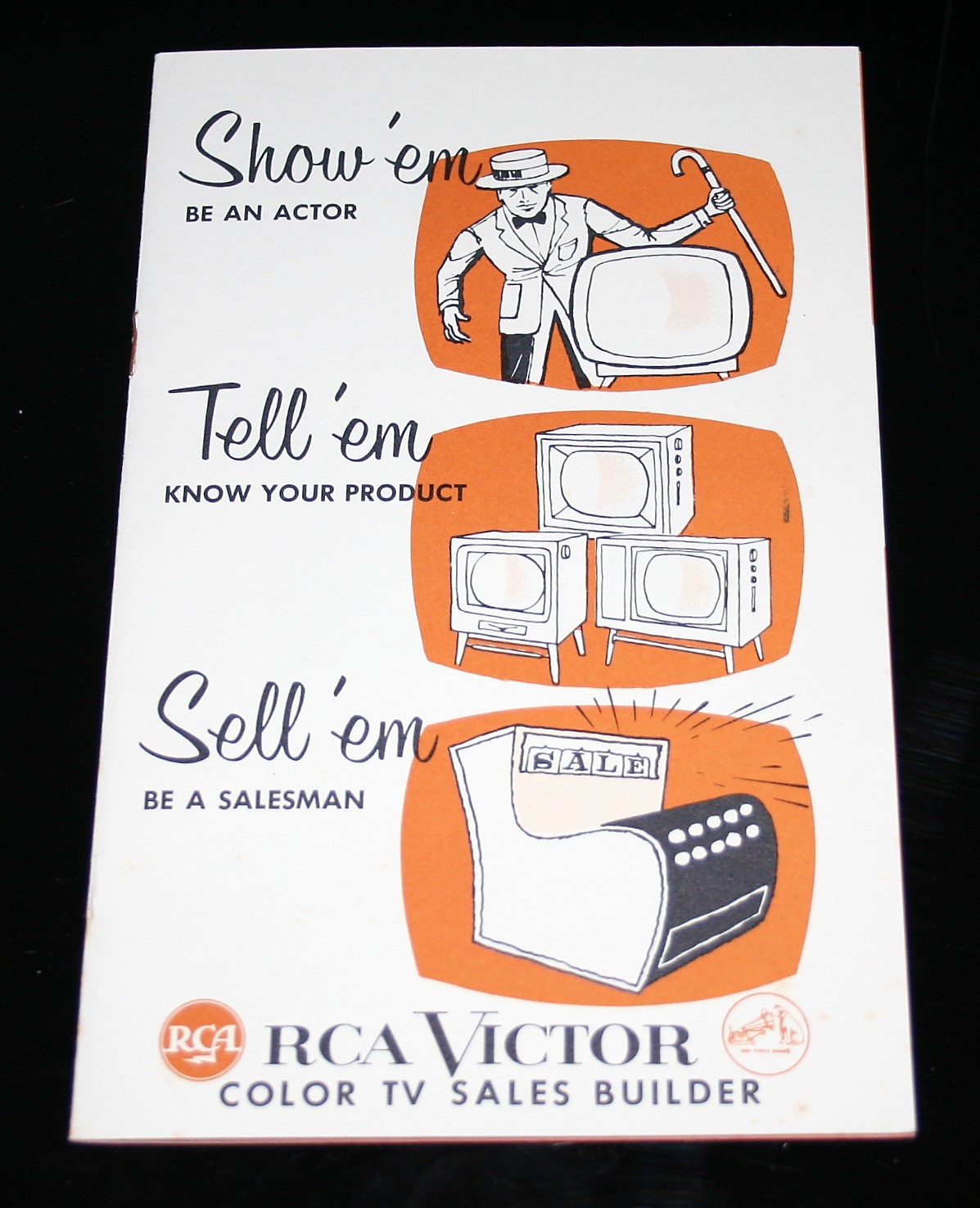
An RCA Colour TV salesman’s kit I picked up recently highlights the above-mentioned stalemate quite clearly. Dated to 1957 it was intended to provide a simple step-by-step guide for all their salesmen and is illustrated and written in the excited 1950s way you’d expect. When it comes to unveiling the secret sales pitch to the reader, then their message is very clear- let the colour sets sell themselves by lending them out and then hopefully reeling in a new happy customer. This approach of course was nothing new, but what gave it a twist was that after installation the canny salesman had to carefully time his return visit to coincide with a colour show his customer might like in order to help seal the deal. With only two to three colour shows in the US per day even in 1957, the life of a colour tv salesman must therefore have been a little less fraught than it is today!
By the late 1960s the tide of colour television was finally beginning to turn as country after country began offering colour transmissions. Combined with new cheaper sets coming in from Asia (particularly Japan) this helped bring the cost of colour tv down sharply. Since the 1960s was an era of pop culture and bold colour, the switch to a colour set by the general population must have felt like a major and exciting jump. Here in the UK we began enjoying our first colour shows (via BB2) in 1967 and have never looked back since. Thus, by the end of the 1970s black and white sets were mostly limited to security cameras, portable devices and for people who didn’t want to pay the full TV licence fee.
As TV memories often intertwine with many of the important memories in each of our lives, then I for one am grateful to the Television pioneers such as Baird for making those memories exist in glorious technicolour.
Baby with TV attribution by Barbara Hanson; Colour TV test by Archives New Zealand;