

The other day I happened across a great piece of forgotten communication technology from the 1980s called the ‘Interlaser’ by a small UK company named Modular Technology Ltd. This had been an optical communication system which could send either data or multiple phone lines back and forth via a beam of light up to 1km away. Their affordable set-up was intended for those businesses or sites where cable connections were not really practicable, and it attracted interest and coverage when announced. The product remained in small scale production throughout the 1980s adding video data to its list of options, but by the end of the decade the Interlaser seems to have finally disappeared from the market (in no small part I’m sure due to the rapid growth of the mobile telephone networks). There is currently only limited information about this product online, so of course if you are able to shed more insights, do drop me a line.

A prehistory
The idea of sending messages through the air is of course nothing new. For thousands of years people have been sending fire and smoke signals to signify danger or important information. From the ancient Chinese and Greeks to the coloured smoke plumes still used by the Vatican today to signal a new Pope, smoke and fire are probably the most universally employed messaging systems there has ever been. But while highly effective at limited long-distance communication, as we know they are pretty useless when sending a shopping list to our partner standing several miles away.
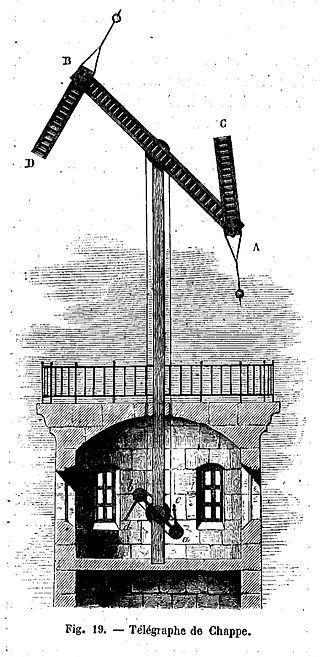
In the late 18th Century Claude Chappe devised a new telegraph/semaphore system using a pair of planks (mounted on tall poles and steeples) which were placed at different positions to signify the letters of the alphabet. Later in 1821 Carl Friedrich Gauss created his Heliotrope which used mirrors and lenses to point a concentrated spot of sunlight over long distance. Initially created for surveying purposes, by the second half of the 19th Century the military were using the approach with Samuel Morse’s code of dots and dashes to send accurate messages. An alternative version was used by the Navy who used bright Aldis Signalling lamps at night while at sea. Although somewhat fool proof, semaphore had its drawbacks as it required suitable weather conditions, a great deal of patience, and little privacy as others could intercept messages with ease.

In 1880 Alexander Graham Bell combined his knowledge of the telephone with the photo electric properties of Selenium to create the first truly optical telephone. Called the ‘Photophone’ Bell believed it would be his greatest invention, but while the device somewhat worked at very short distances it suffered from the same environmental issues as the above. Bell’s invention was further explored by Ernst Ruhmer in 1901 who was able to use a modified version to send his telephone messages up to 5km in favourable conditions. However, it was the word ‘favourable’ which really remained the sticking block for this device as well as the lack of a really strong and focussed light source. Ruhmer had employed large German Navy signal lamps in his experiments but naturally these were not available for everyday use. Thus, for many years good old-fashioned semaphore by lamp or mirror remained the best solution of optical communication. It was not really until the invention of the Laser in 1960 and LEDs in 1961 that the technique was able to progress further. By utilising these new concentrated light sources with digital (ie Binary) coding, it was finally possible to accurately send much larger bursts of information through the air.

The Interlaser system of the 1980s.
While the Interlaser system had competition from overseas, it appears to have been the only UK device in this exciting new space. According to a short piece in the New Scientist of 1981 [i] the Interlaser system was first created by Modular Technology in July 1979 when they and a business across the road from them wanted to set up direct links. The companies had both patiently waited 8 months for an official Post Office telephone line and growing weary decided to take matters into their own hands. Almost instantly the giant provider British Telecom tried to get Modular Technology’s new device taken down because they felt the system broke their communications monopoly, but since it posed no health (or other) hazards and didn’t interfere with their landline monopoly agreements, they were not successful. Recognising the potential large market for this optical communication device the small Watford based firm of Modular Technology set about turning it into a viable commercial product. In the end the set up would involve a modem that would convert the data and a receiver/sender head that would collect and send the data.
By 1981 things had changed for BT who were now actively looking to purchase a laser or microwave system in order to upgrade their own communication network within the City of London financial district. As the New Scientist article put it: “The crowded ‘square mile’ contains an old terrestrial telephone network which is creaking at the seams”.[ii] Although BT looked into several overseas companies who were offering solutions, they also did a U-turn and considered the Interlaser system as well. I don’t know who finally won the contract, but unlike microwave or radio communication, the Interlaser system was affordable, safe and required no licenses for use. Each connection could provide up to 0.5 MBPS (million bits per second) of data transfer or 30 telephone lines. One set up then would happily serve a small office.
So far I don’t really know who purchased the Interlaser systems, but we do know Standard Chartered Bank did when they moved some of their staff to new offices on the other bank (side) of the Thames.[iii] By 1984 Modular Technology had improved the devices further to also include video data and the same year the Department of the Environment were using a few sets of Interlasers on top of their traffic signals. Around the same time we also know that Modular Technology began promoting their kit to factories with the approach that they could be used to communicate with the various industrial equipment and machines without interference.[iv]
n 1987 an article came out in Radio and Electronics World to promote a new range of Video oriented Interlaser heads, but how successful the product was we just don’t know.[v]

How well did it work?
According to the articles found, the Interlaser system had around 95% reliability up to 1km away and since the signal was created from rapid pulses of light sent via a narrow beam, the connection was considered quite secure from prying eyes. An included scope meant the main units could be set up quickly and without expertise, and the simple to mount boxes counted as both transmitters and receivers. Despite being given a host of different serial names, there were really two main versions available to purchase. One used LED lights and could only reach up to 200M (this kit cost £2500 in 1986), and the other a more powerful version which used class 3B lasers that could stretch up to and beyond a few Kilometres (that kit cost £5000 in 1986). By 1km the projected light beam spread to around one metre in diameter and auto-correct software meant the signal was reputedly not disrupted by medium thickness fog or flying birds. Obviously you always needed a direct line of sight and there were some atmospherics which were less favourable, but overall the Interlaser system appears to have been quite a robust set up for its day.

The writing on the wall
While Modular Technology had correctly spotted a potential gap in the market back in 1979, that gap would narrow and ultimately disappear as the 1980s progressed. The UK launched its first mobile cell network in 1985 and while this did not initially compete with the data transfer capabilities of the Interlaser system, it did probably close the market for phone connections. There still remained a need for bespoke short-range communication such as inside factories, the transport network and for security systems, but these were quite niche uses and probably didn’t provide the profit margins the company needed. At the same time the computer industry was booming in the UK, and from what I can tell Modular Technology chose to realign its efforts to focus instead on providing modems and other digital systems. The company was bought out around 1990 but continued to supply computer devices for some years after that.
References:
[i] ‘Telephone flashpoint lets in lasers’, New Scientist, 11th June 1981.
[ii] As above.
[iii] ‘Machine communication using lasers’, Robotica (1984) Vol 2, pg66.
[iv] As above.
[v] ‘Interlaser’ Radio & Electroncs World, January 1987, pg21.