
(for West Country Life- August 2020)
Back in the mid-19th Century the London based Society of Arts decided to hold an annual exhibition dedicated to the best new inventions. They ran the event for about twenty years and were happy to traverse a very wide range of fields provided the exhibit was an interesting new patent or idea. Much like trade exhibitions today, this event would have been THE place for any self-respecting entrepreneur to mingle and network in the hope of selling their idea to a wealthy investor or two, and must have been a buzz of people and live demonstrations . Naturally, the range of inventions on display varied from the banal to the ridiculous but given the prestige of the organisers must also have launched the careers of at least a few of those taking part.
Now like many of us, the last few months of lock-down gave me ample opportunity to waste far too much time on the internet not just vegging out to Netflix, but also lost in research. And it was while searching around one day that I stumbled upon a few of the digitized catalogues from these Society of Arts Exhibitions. While I’m usually found delving into the history of far more recent gadgets and inventions, I must admit these older items fascinated me none the less.
Summarising the content, it is fair to say that many of the inventions offered were things I have simply never heard of (meaning they were probably forgotten as quickly as they emerged) or were very minor modifications to existing ideas such as a better way of making lead pencils (yep that really was there). But amid the inevitable all-too-forgettable entries, there were a few which were amusing or far-sighted enough to share here.

Had you been wandering the Exhibition hall in 1859 and stopped at stand 259 you would have found a panelled wall made up not of heavy solid wood but of wafer-thin veneer only. The idea of this veneer was that it was laid straight on top of the plaster to mimic the real thing and not only provided the look without the cost but was also inflammable in case of fire. The threat of fire and fire prevention was clearly a major issue at the time and many other inventors came up with clever contraptions to escape a fire filled room. Mr J White of Finchley had invented what we would recognise as a breathing apparatus complete with a head covering, mouthpiece and tube leading to a tank of air on the person’s back. Of course, this being 1859 the air cannister appears not to have been pressurized in any way so one can only image your air supply was limited to the tens of seconds rather than minutes.

There was a patented fire alarm by Mr Taylor of Southampton which had a metal tube with a diaphragm on which in turn connected to a bell and striker. The idea was simply that as the fire heated up the outside air temperature, so the internal pressure in the tube would also be forced to expand setting off the bell. While the idea was clever in theory, the room would need to get pretty hot to cause the amount of pressure change required to trigger the bell, by which point you were probably sadly already toast or standing outside with buckets.

In the event of fire, if you had a window that was your first point of escape. But if you were several stories up and a lady then there was no way you would ruin your reputation and dress by climbing down any form of ladder or rope. Instead in 1861 T J Peddar offered a far more genteel form of escape with what can only be described as a fixed bottom tent suspended on a winch to the outside of your house. You calmly climbed in, winched yourself down, and strolled off without a mark to your chenille.

For those wanting to shield their eyes from the summer sun then J Kalkin of the Strand had a rather dapper pair of eye shades on his stand. A simple ventilated sun visor (long before they re-emerged in the 1980s) was called the ‘Occhiombre’ and reputedly kept out dust and wind as well as glare.
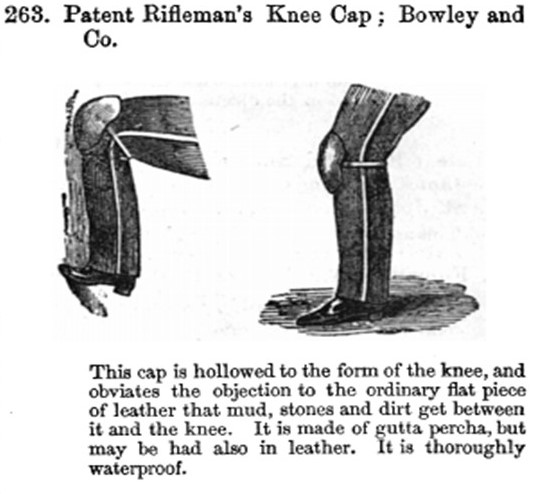
Staying with useful clothing and accessories there was a ‘Patented Rifleman’s Knee Cap’ which yes as you guessed it was just a knee pad (so what made it patented who knows?) and there was a pair of clogs designed not to look like peasant’s footwear, but fashionable high boots instead.
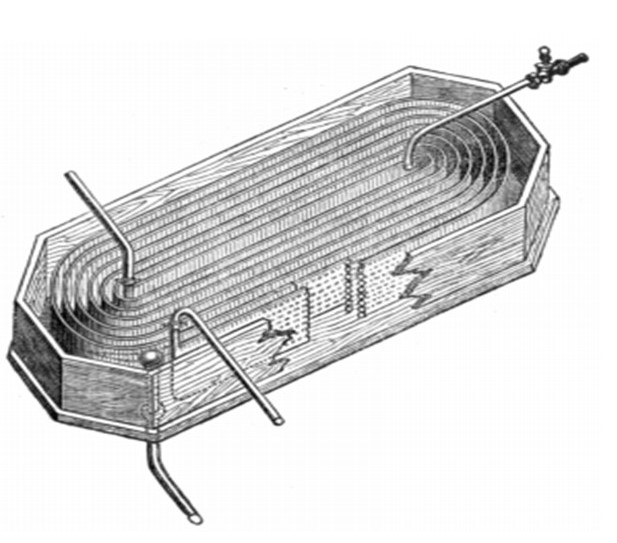
Moving indoors there was an interesting patent refrigerator which worked by running cold water around a maze of thin corrugated copper plates. With lots of surface area the copper would naturally cool quickly in turn cooling the compartment above it. This was indeed an interesting and early solution to a refrigerator (that didn’t require ice) but would have needed a constant source of cool water to prevent it warming back up.

On stand 186 in the 1861 exhibition was ‘Colin Bullinger’s Registered Automaton Mouse Trap’. This intriguing little box was set up to not only capture a mouse humanely, but also using weighted floors to reset itself once the little guy had been caught. This contraption did not rely on food or poison but the mouse’s natural inquisitiveness to climb down tiny corridors that would subsequently close to prevent them scurrying back out. Looking at the inventiveness of the trap one wonders if the inventor had not been more of a mouse lover than a hater, but whether any mouse ever completed this miniature crystal maze to find itself ultimately trapped is anyone’s guess.

Of course, unusual inventions were not the exclusive preserve of the Victorians and while most may appear simply foolish or pointless to us now, at the time they were clearly attempts to solve real-life problems. While we are all too familiar with the famous success stories of past innovation, catalogues such as these from the Society of Arts reminds us that success is a hard thing to achieve and more often than not, great ideas fall flat instead!