

95 years ago the Scottish Inventor John Logie Baird (known to his friends as JLB) became the first person in the world to create the first flickering images of what we would call television. His practical tests had taken just 2 years of intense dedication, had nearly electrocuted him on one occasion and had soaked up all his savings leaving just £30 in the bank when the breakthrough finally came. Unlike many inventors Baird did not come from a long career in research nor did he have the backing of a multi-million-pound lab. Instead he epitomised the image of the slightly eclectic lone inventor relying on card, a shipping crate, old bicycle parts and a whole lot of creativity to beat his global competitors to the coveted prize of television. By all accounts Baird was an unlikely but inspirational inventor.
JLB’s 1925 landmark was just one in the full development of modern Television which would take several decades and many clever people, but while others before Baird had managed to create shadows only, his new mechanical process (which used a spinning wheel called a Nipkow Disk) offered the first successful greyscale moving image. Indeed, so advanced was his approach that for nearly 2 years no-one else in the world was able to offer any suitable alternatives. Finally, in 1927 the Americans (under the RCA company) managed to demonstrate their own version of TV using an electronic process. This better approach would overshadow Baird’s lead and his inability to give up on the mechanical approach would ultimately damage his new company and reputation.
JLB sadly died in the summer of 1946 at the tender age of 56 and while many people know of his Television story, very few know that he ever invented anything else of note. Infact Baird held a string of patents for different inventions, some more successful than others but many quite ground-breaking and forward thinking in their aims. Unsurprisingly many came out of his development with TV.

Noctovision
One of the first things Baird invented after his initial success with TV was a process he would call ‘Noctovision’. This was the first attempts at night-vision and at one point was seriously considered by the Navy and coast guard for helping locate stranded ships in fog and at night.
In 1926 the first TV screens were merely the size of a postage stamp and bold make-up and extremely bright lighting had to be used to enhance the natural contrasts of the face in order to make them discernible. Indeed in a few of his earliest tests the lights were so bright that JLB nearly melted the dummy head test subject (called ‘Stooky Bill’). Naturally he recognised that you couldn’t run an effective broadcast service under such intense conditions. This led Baird to reconsider the whole issue of light. In what can only be considered a stroke of genius, JLB realised that since the light sensor which collected the light was not subject to the same restraints as the human eye, then there was no real reason why his process would not work outside of the visible light spectrum either.


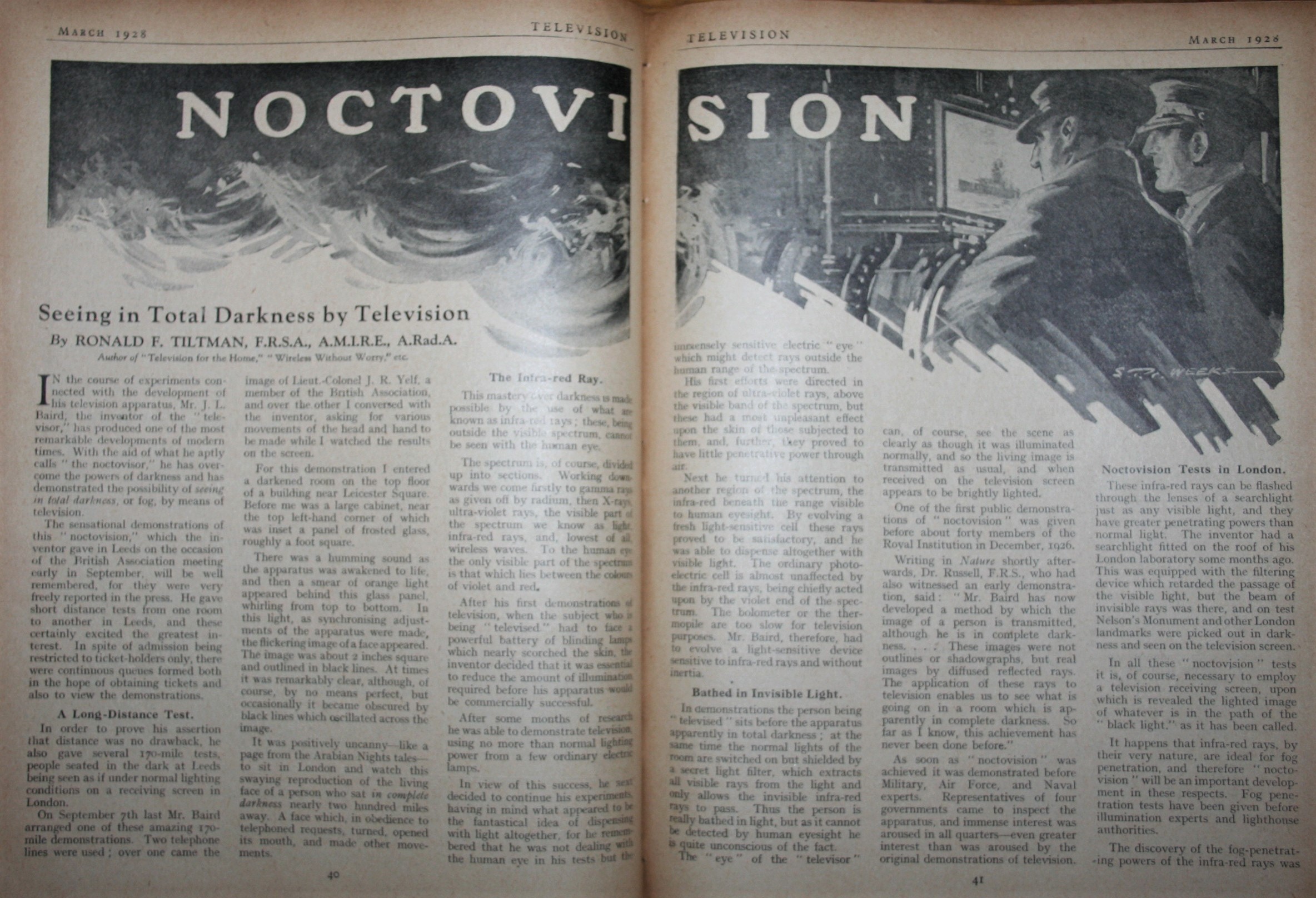
In 1926 tests were conducted which replaced the regular lamps with ultra-violet ones. When Baird quickly realised that these were causing discomfort to the young office boy he had asked to be his test subject, they were rapidly swapped for infra-red lights instead. These result proved surprisingly effective and in a black room people could clearly be discerned. JLB gained some notoriety from the press for this pioneering invention. He conducted a test to show the image could be seen even through dense fog and the results transmitted over long distances (170 miles away) via telephone line, but his invention sadly never went any further.

Phonovision
In 1927 while Baird was looking into the way his pictures were transmitted, he once again stumbled across another fascinating idea. Television of course was a live process, but by intercepting the signal and routing it to a record cutting machine JLB was able to record the image onto a standard 78 record as an analogue audio sequence. This was in effect the world’s first video recorder, but because even Baird himself could not yet reverse the process successfully, it remained a tantalising idea.
Finally in the 1990s a few original phonovision disks that had been recorded by Baird and others at the time were successfully converted back to video to prove that they were indeed the earliest video recordings ever created. Considering how crude the process was moving images could certainly be seen.
Colour, High Definition, 3D TV and more
The amazing thing about the story of John Logie Baird is how little he invented before 1923, and how much he invented afterwards. As a young man at the turn of the century he had patented a new kind of thermally insulated sock for people (like himself) who suffered from chills. He sold these around Glasgow to a fair response, but apart from turning his hands to a few other small failed businesses Baird attempted little else during this time. However, from 1923 (when he first dedicated himself to the development of TV) until the time he died in 1946, JLB would become a powerhouse of ideas.

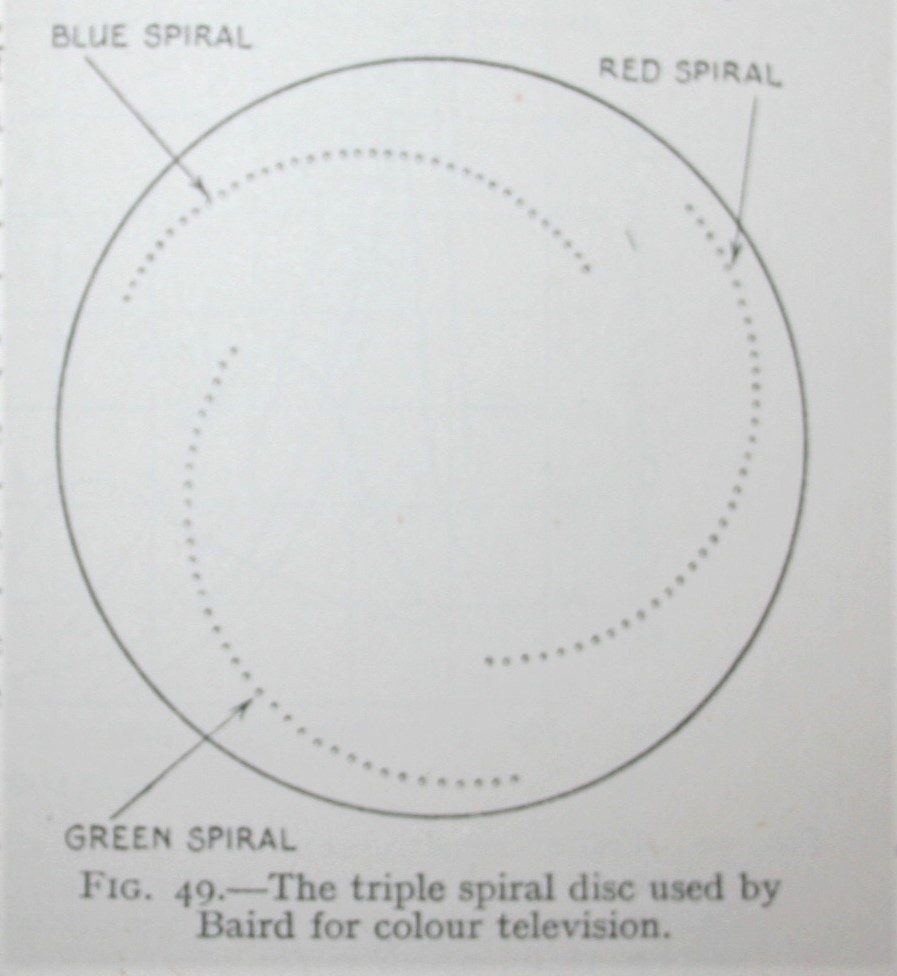
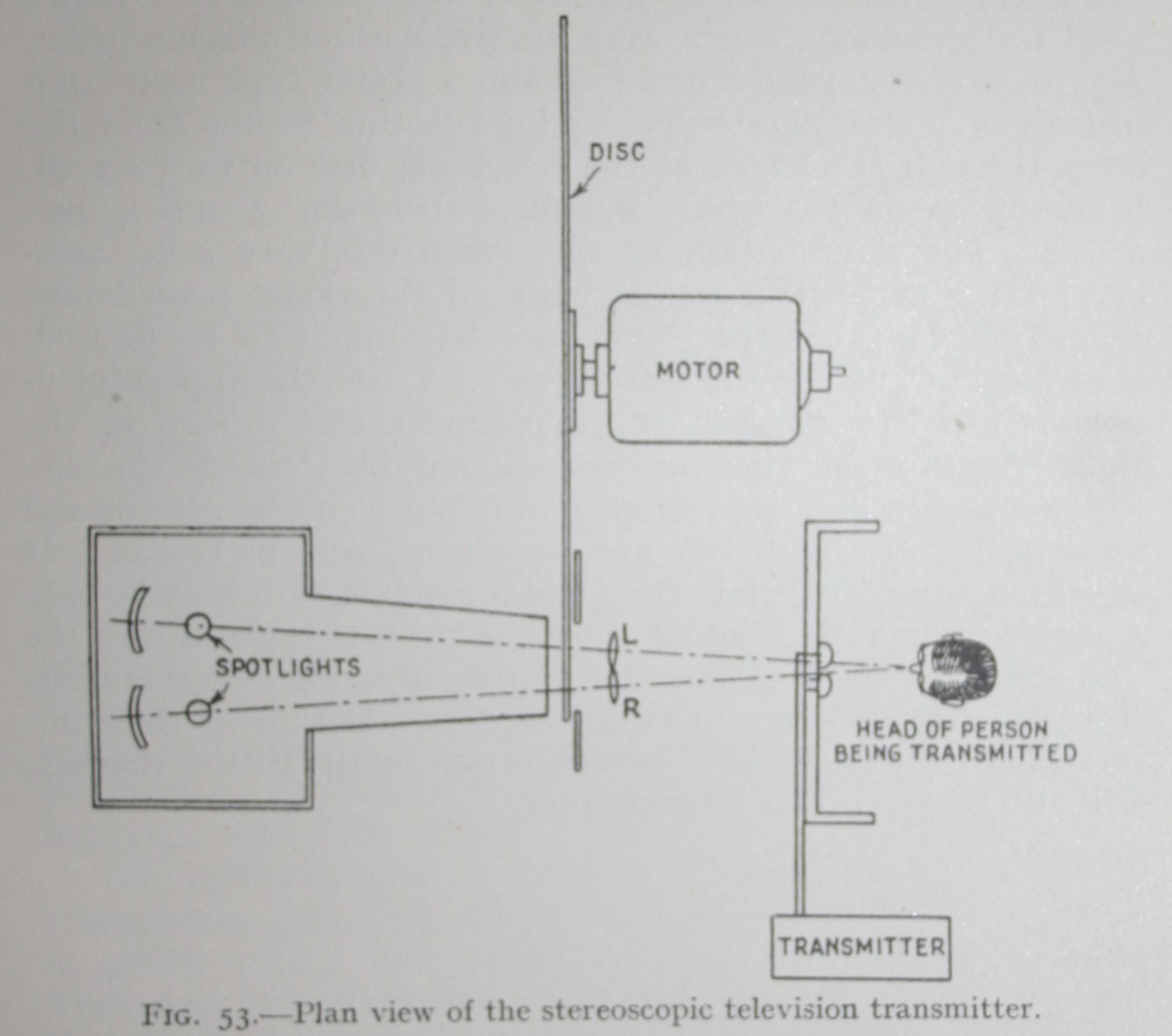
In 1928 JLB became the first person to demonstrate a crude form of colour television by using a spinning colour wheel to trick the eye into assigning natural tones to the image. This was followed up with the first true demonstrations of colour TV at the end of the 1930s. At the same time by using two cameras to record the scene and overlaying the images on the screen, he also created the first 3D effect TV.

During WW2 Baird worked on the first High Definition TV (of over 1000 lines) and reputedly secretly helped design high end electronic parts for the war effort. Back in 1926 Baird patented what was considered by some an early form of radar (years before anyone else), and also helped develop a type of early fax machine just before he died. He worked on developing fibre-optics, an early form of sat-nav using radio signals and much much more.
The list of JLB’s ideas, inventions and patents goes on and on and personally I can think of few other inventors who matched the quantity and pace of his output. Had Baird lived even a few more years, who knows what other amazing inventions he could have offered the world!
