
One of the words that best summarises the 1960s is surely ‘style’. Style in its most basic form is the magical blend of form and function which fuses together to create a meaningful and hopefully timeless statement.
As the booming English electronics industry entered that swinging 60s era, it correctly realised that in order to survive it would need the help of some fresh and progressive designers. The electronics giant Pye of Cambridge was one such company looking to rejuvenate its product line and in 1965 placed an Ad in the newspaper appealing for new blood. The job was given to an up-and-coming industrial designer named Kenneth Sadler.
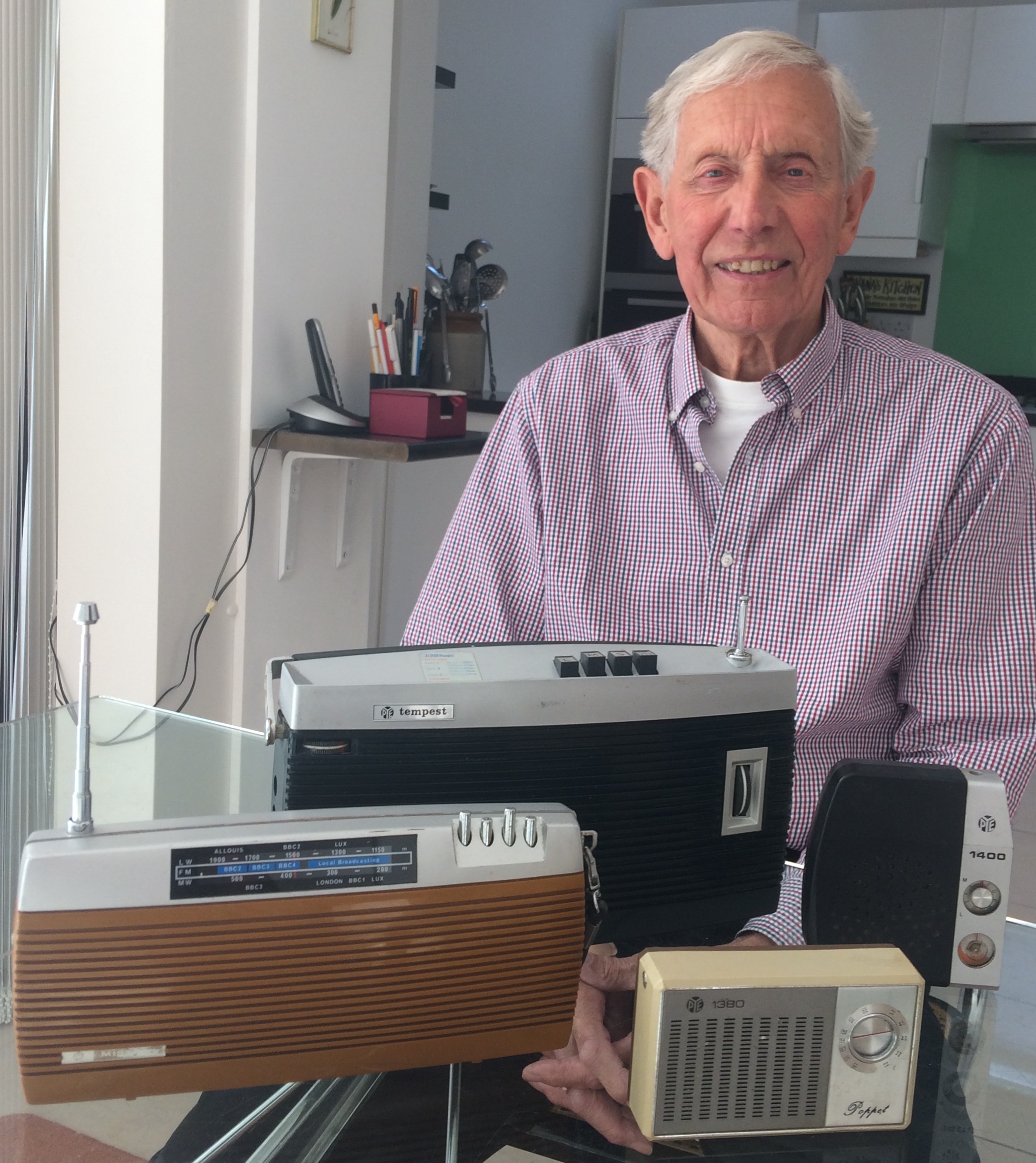
While I have previously written about Ken’s early career before Pye helping to design elements of the Atlas Super-Computer (click here to read it), I was very pleased to sit down with him again to discuss his time with Pye designing radio’s and TV’s. As he spoke, I was fascinated with Ken’s insights into the whole design process, as well as his inspirations behind some of his more well-known models.
Though a humble man, Ken’s illustrious career has now spanned over 60 years and includes many highlights such as designing components for the Manchester Atlas Computer; a series of radios, Televisions and medical equipment for Pye Ltd (including their 1st pocket radio); wheelchairs and aids for disability, his own successful architectural practice, as well as winning the coveted ‘Queens Design Award’ in 1989 for an innovative pocket blood monitor used for many years by doctors and nurses around the world.
Since turning Ken’s words into prose would have diluted some of his fascinating detail, in this instance I have decided to offer an edited transcription below instead……

Edd: How did you get a place at Pye?
Ken: Well it’s a long story but I graduated from the Royal College of Art in 1960, and I won a travelling Scholarship so I was in and around Italy and places like that for several months. Once back my first job was at Wilkes and Ashmore in Horsham in West Sussex. The founder Ted Wilkes was a very keen sailor and he had been working with Pye at Cambridge on their Nautical Instrumentation. They had just won the Prestcold Design Award for Refrigeration for Prestcold in South Wales. There was a good team of people there, some from the automotive industry and Ted himself did a lot of work for British Rail. So we had a big mixture of Pye staff doing technical radios for the nautical industry, railway design work and domestic appliance work. For any new designer coming out into the real world it was very difficult to get that kind of combination, but I really enjoyed it.
In 1965 I had started to work on my own because that was one of the things that happened in the industry. I answered an ad (I think it was the Sunday Times) which wasn’t really cast in the terms of ‘looking for a Radio, Television, instrumentation designer’, or for that matter for any sort of designer! It was written by a man called Bill Reed, who I found out later was the commercial manager for Pye at Cambridge. He was a South African man and he wrote this Ad that intrigued me as it was looking for something magical, almost like a Kaleidoscope into what they needed and wanted to do. So, I sent off a little handwritten letter to the advert not expecting to hear any more and I suddenly one day got called for an interview at Cambridge. I went up there and we met at St Andrew’s Street (this was their factory) and I learned a little bit about the group and what they were doing. Bill Read said to me “look I’d like to give you a project to do just to see how you get on”.
So, I came back home and thought about it as there was no written or even verbal brief. It was “…we need something, we’ve got to move forward. We’re in the swinging 60s and we’ve got some people in the workshops, and we’ve got wonderful craftsmen to do the wood cabinet work and we’ve got lovely moulding facilities…”
At that time Pye were liaising with people in Hong Kong and Bill Reed said to me: “look if its good it will probably be made in Hong Kong”. I said ok, I would see what I could do. We agreed it would be a portable product because that was what they were really looking at since they had the grand pianos and beautiful radiograms and that kind of thing already.
At Wilkes and Ashmore I had just been working on designs for the Atlas Computer at Manchester University and some of my work there had been very much in the design mould for electronic equipment and computer-style furniture. But this actual product had to be a miniature. They wanted a pocket radio so this is what I did. It was called the Pye 1380 and was a little portable radio manufactured In Hong Kong with only a small amount of electronics. All packaged in it had to be not much bigger than a pack of playing cards with some components from Japan and some from Hong Kong.

Edd: What was your design Inspiration for the 1380?
Ken: Well we had to make it small, with a small tuner and easy to read. There had been one other pocket radio at the time that had been made by a fashion designer, I think he was French. I had seen it in the high street in one or two of the shops in Pall Mall in London and I thought it was very interesting that you could get a little radio that you could pop in your pocket and use in that way. They called mine the ‘Poppet’ though we called it the 1380, and it said ‘Empire Made’ on the back because Hong Kong was still part of the British Empire in those days.
And so that was where it all started. It seemed to sell well and had one or two derivatives for the Ekco part of the group (although Ekco which was part of Pye did make rather larger radios at the time and were competing against other companies such as Bush). Bush subsequently took on a designer as well at the time, although I think he had experience in the automotive industry as he designed a slightly more sculptural radio with a handle that went over the top.

Edd: so which came first- were you given the innards and designed the case around it, or the other way around?
Ken: I think we did it two or three ways. You can see on the molding it was manufactured by Coronet Industries who were the Hong Kong Factory, and they gave us some basic parameters about what they thought they could do (ie. playing card size). It was a bit fatter than I thought because of the way the height of the transistors sat up on the board and you had to shoe-horn a lot of things in. Basically, it became geometric because the way they could squeeze everything together was on a flat board almost 5 inches one way by 2 and half inches the other. Although they wanted to make it as small as they could, there were limits obviously due to things like the speaker being two and a half inches round etc and we had to get the dial in.
It was relatively easy to design being on the square, and the mouldings had to have draw angles off of them to be tooled. As we were not able to go to Hong Kong to see what tooling they had, we had to make some basic assumptions instead so kept everything quite straight forward. I was always grateful to Bill Read for his foresight in employing me, and his successor Richard King who also employed me to do the next range of products that were more sculptural.

Edd: Was it just yourself designing or a team?
Ken: No it was just me. When Richard King took over he had another gentleman named Tony Walters who was very much the liaison with Hong Kong for the later models. But I was just pleased to get something tangible and it was a very practical approach at that time. There was a moulding part of the group ‘Ekco Plastics’ over in South End who also wanted to get in on the act, but I never worked with them directly because they kept very faithful to their Ekco brand producing household goods etc.
Edd: So from start to finish how long did it take to design each radio?
Ken: Well it was months only, we worked very fast really.
Edd: Tell me a little about the TVs you designed?
Ken: Well Pye moved me onto some Television work which was quite exciting in a way because I did the first colour televisions for them. It was intriguing because when they were introduced to the market they were labelled ‘Pye’s colour televisions’ when in fact it was just the cabinets that were coloured. For the cabinets we first used a Papier Mache mould and we wrapped it round a mandrel almost that shape, cured it so it was rigid, sliced it off, then we coated it with a flexible fabric to make the colour texture of the fabric.

At the time Robin Day was the resident designer at Pye for Radiograms and cabinet furniture like that, and I can see now that my work in contrast was focussed on what they could manufacture using moulded products from the Far East. So Robin and I worked on different briefs really.
Edd: What were your design inspirations at the time?
Ken: Well it was very much Pop Culture as I’d been very interested in it both at the Royal College of Art and at Wilkes and Ashmore. Pye Radio products for the nautical industry were very small and I felt that was an interesting lead as people didn’t want to carry around heavy things but portables. And of course the sculptural element came in also. I spent some time at one or two of the beeches on the South Coast where we had these beautiful granite rock formations and stones that had been smoothed off by the waves of the sea, so the inspiration for the latter radios were these lovely sculptural lozenge shaped rocks from the beach.

I did some drawings for an exhibition that we had in Manchester (which Tony Walters set up) and I drew the stones all together for this. Of the 3 radios that came out of the Hong Kong factory subsequently (which we designed) it had to be a marriage between the technology that could be achieved and the sculptural forms I was looking for. They were almost like lozenge shaped effects and the plastics were mainly governed by what the factory could do in Hong Kong.
Of course, the early plastics were very brittle, so we were always looking for more robust plastics and designs for the next radios. It is why I chamfered the edges on my first radio (Pye 1380). With the latter softer forms they were more robust and didn’t have any impact on a corner if it was dropped (nor the parallelogram-like effect you had when you dropped the earlier squared ones). Indeed, without the back on it the 1380 radio would have been very weak as a moulding, but this didn’t happen on the latter designs.


Edd: So what were your next radios?
Ken: After the 1380 it was the Pye 1400, and that internally had a very similar flat board to the last- a PCB with equipment on it, slightly different battery format, the speaker once again dominating the bulk of the product and in the Pye World it was nicknamed ‘The Camera Radio’. We’d have been delighted in those days if we had iphones with cameras in and cameras were nowhere as near developed as in the iphone, but that would have been an aim if we could have done it.

While the Pye 1400 was partly based on the beach stone experience, it was the subsequent ‘Mistral’ radio I designed which really took the lozenge-shape more fully. It was double sided, split down the middle, and 3 band as FM was just filtering into the radio world at the time.
The Mistral was the first radio we did which used a different texture beyond what they could do in Hong Kong. We had to do these textures because by reducing the surface area that touched anything (ie by the pimples) you didn’t get so many scratches so it would look nicer for longer.

Edd: How long did your radios stay in production for?
Ken: In the long term what tended to determine a lot of it was the technology inside. The idea of a flat circuit board which could be populated quickly and easily gave rise to many changes in what they could do.
We followed on from the Mistral with a slightly bigger radio called ‘The Tempest’. These were not names I chose. The Mistral name was chosen by Tony Walters and was derived from the Rhone Mistral that cuts through France and divides around Lyon after which it is a wind that carries on through the Continent. Tony was a big sailor on the East Coast and thought that with this radio we would ‘spread our wings into the Continent’ so chose Mistral as a name. He also named the Tempest radio as well. There was a very famous radio show at the time which started with the sound of seagulls and the sea breaking over the rocks which was quite a strong feeling when listening to the radio and I felt I wanted to explore that theme some more. Also, these were out and about radios that you would take to the beach etc, not just left on the sideboard at home or in the garage, so you’d want something that was not too angular.

There was a very nice version of the Mistral in dark green which I preferred, a blue one and a yellow ochre colour (which was inspired by the timber experience of the factories making the timber cases at the time). We wanted to stay away from the leatherette feel that was quite strong in the early days, so coloured plastic was introduced to give more of a modern feel instead. The Tempest came in two colours if I remember-blue and dark green which was supposed to be British racing green. The colour specifications in those days for moulding powder were nowhere near as developed as it was for paint. For the paint we had the British Standard and the Munsell Range which was developed from the colours used on military vehicles. Colour choices back then were not necessarily driven by what colours were popular for interiors, they were more ‘out and about’ colours.
The Tempest had 4 bands which shows again how the technology was moving forward at the time. It was a bigger more substantial radio so could sit on a sideboard, in a boat or even a motorcar for example. Interestingly Pye did offer specific car radios at the time, and I designed one of these for them.
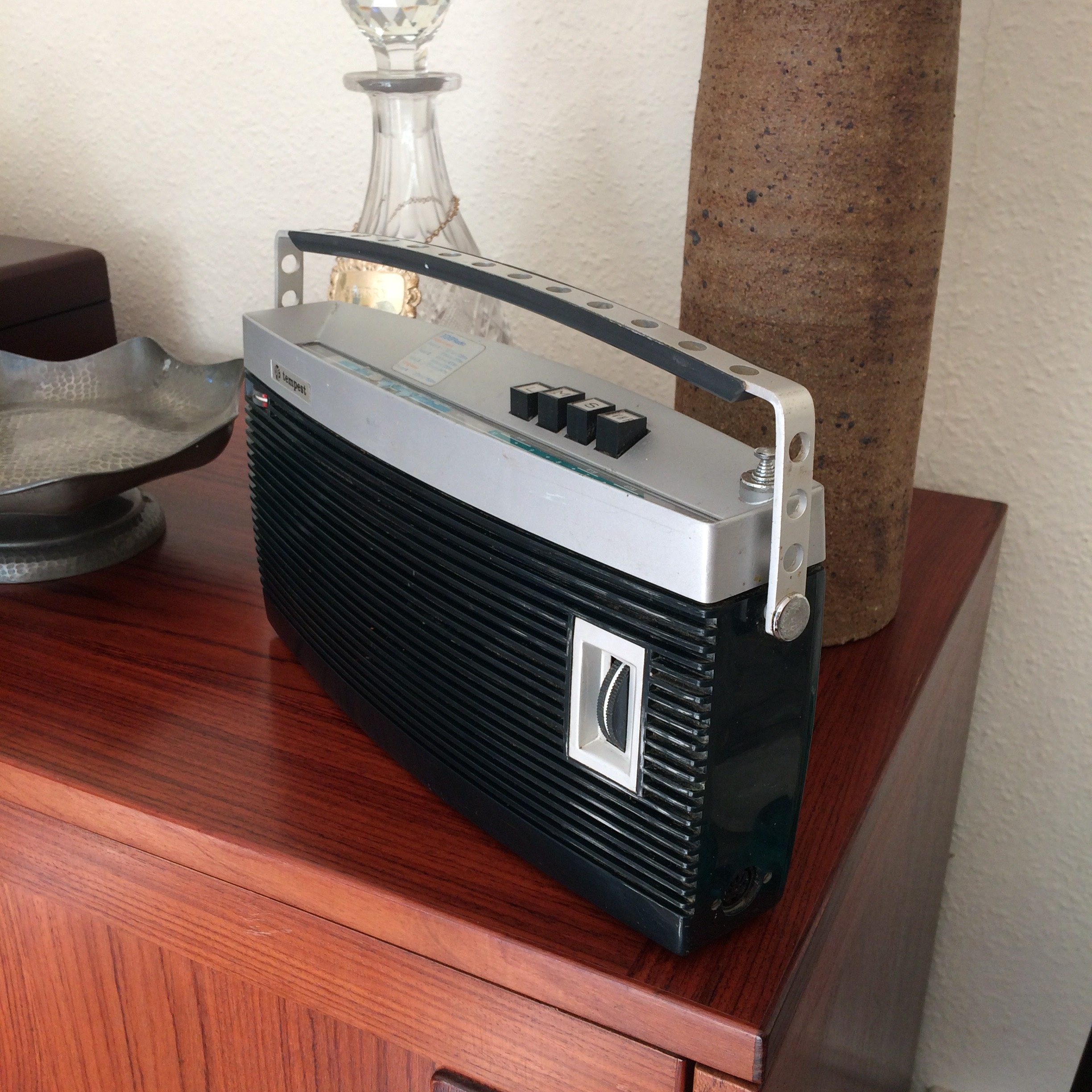
Edd: Why did you have a design change with The Tempest putting all the controls on the top?
Ken: The reason for that was because it was seen as something to be put on the sideboard not stuffed in a briefcase or pocket. You got a bigger grill and thus a better sound as you’d want to be listening to VHF- perhaps to a concert or The Proms in higher definition…. Strangely as the continued development of transistors meant other products were going down in size, this range was getting larger!
Edd: And finally- when did Philips come into the picture for you?
Ken: Philips did not enter the picture until after this range were released and I don’t remember them having anything similar, but they were very big in the TV end of the market. They were very taken by these plastic televisions. We had Ekco, and then we had Pye, and now we had Philips coming into the picture as well. I was not party to what Philips management were looking at (or for that matter how they came to acquire the company) but they did have a strong history of European design and we were not sure how that was going to impact the Pye group…..but it certainly brought a curtain down onto that era for us either way.


Photo attribution: All period advertising and design drawing images courtesy of Kenneth Sadler